


Central Asia: a new chapter

Contents
1. In the shadow of the war in Ukraine. International determinants of the situation in Central Asia
2. Authoritarian regimes ‘enlightened’ to varying degrees: the domestic situation
1. Central Asia and regional security challenges
2. Islamic radicalism and the drug route: overstated threats?
1. In search of a new development model
2. Hydrocarbons and critical raw materials: another chapter in the Great Game?
3. Connectivity first? Transport issues
1. Society: a new actor in the Central Asian states?
2. Central Asia on the move: migration from the region. The case of Poland
INTRODUCTION
Central Asia is in the midst of profound political, economic and social transformations. These are driven by internal dynamics, including the consolidation of local regimes, the region’s ongoing modernisation, integration processes and demographic and identity shifts. They are also shaped by rapidly changing external conditions, notably the consequences of Russia’s invasion of Ukraine and growing interest from external actors, together with the region’s increasing economic appeal, stemming in particular from its natural resources and transport potential.
This marks the third such moment in the history of this part of the world. The first came when the Central Asian states gained independence and opened up to the outside world in the early 1990s. The second followed the global changes triggered by the terrorist attacks of 11 September 2001, notably the war on terror, which extended to neighbouring Afghanistan and led to closer cooperation between the Central Asian republics and the West. The processes unfolding today carry a considerable degree of uncertainty, but they have also opened a unique window of opportunity to develop relations between the region and the EU and its member states, including Poland.
Under current circumstances, a degree of synergy is emerging between the opportunities and interests of Europe and Central Asia, encompassing economic cooperation in areas such as raw materials, transport, trade and investment, as well as political engagement and broader security issues, including stability and the preservation of the international order. Given the rapid pace of change in Central Asia, developing an effective framework for cooperation should be regarded as a necessary condition for strengthening ties over the long term. At the same time, despite the potential, ambitions and declarations on both sides, elevating these relations to a genuine strategic priority does not appear realistic.
This report analyses the current political, security, economic and social situation in the Central Asian states, while outlining the key assumptions, objectives, opportunities and challenges of Polish and EU policy towards the region, along with a set of recommendations.
Substantive work on the report was completed in December 2025.
MAIN POINTS
- The situation of Central Asia in the international context has been redefined primarily by Russia’s ongoing invasion of Ukraine. On the one hand, it has made the threat posed by Russian imperialism more tangible. On the other, it has increased the region’s importance, activated external actors and strengthened the agency of the Central Asian states. At present, there is a substantial degree of strategic alignment between Europe, the United States, Turkey, China and other powers interested in maintaining stability in the region and stimulating its economic development and external connectivity, effectively at Russia’s expense. Over the longer term, however, competition and tensions among these actors are likely to intensify, with China retaining a privileged position. The greatest long-term threat stems from Russia’s neo-imperial expansion.
- Domestically, the fundamental challenge lies in adapting the now well-established Central Asian states and their authoritarian political systems to new demands, as reflected in the search for new models of political and economic modernisation. These processes are most advanced and have been progressing most rapidly in the region’s strongest countries, namely Kazakhstan and Uzbekistan. Efforts to identify drivers of modernisation and solutions to strengthen state resilience and capacity are the main reasons behind the high degree of openness of the Central Asian states to international cooperation.
- In the security domain, many of the earlier concerns related to potential conflicts – such as those between the Central Asian states or stemming from developments in Afghanistan – have either receded or proved to have been overstated. At the same time, a deepening crisis is eroding the formal and informal ties underpinning the post-imperial ‘post-Soviet order’ that has existed since the collapse of the Soviet Union. Russia’s neo-imperial ambitions have transformed it from a guarantor of fragile stability into the primary threat to regional stability, particularly for Kazakhstan. The danger it poses would grow significantly if the war in Ukraine were to end or be frozen on terms favourable to Russia. In this scenario, China appears to be the only actor with the means to counter any aggressive moves by Russia.
- Positive trends dominate in the sphere of soft security, with limited scope for the growth of Islamic radicalism and terrorism. However, such conditions exist outside Central Asia. Challenges and threats within the region itself could emerge only in the event of a deep and prolonged crisis affecting the Central Asian states. A certain risk of radicalisation among citizens of these countries also extends beyond the region, including to the EU. The traditional threat posed by organised crime and drug trafficking, linking Central Asia with Afghanistan and carrying implications for Europe, can currently be regarded as relatively limited.
- In recent years, economic conditions in the region have improved significantly. This stems both from a substantial increase in foreign interest – driven by the war in Ukraine and the need to reduce dependence on Russia – in the region’s traditional assets, namely natural resources and transport potential, and from domestic developments. The Central Asian states, particularly Kazakhstan and Uzbekistan, have been actively seeking a new model of economic development by identifying alternative growth drivers, markets and partners that would enable them to diversify existing ties and enhance their competitiveness.
- Russia’s invasion of Ukraine is among the key factors drawing attention to Central Asia’s energy resources (oil, natural gas and uranium) and critical raw materials, including rare earth metals. Moreover, as a consequence of the ongoing energy transition, interest is growing in the region’s potential for producing clean energy. The war has compelled external actors to pursue efforts aimed at phasing out supplies of Russian resources, while providing the region with a major impetus to reduce dependence – primarily on Russia, but potentially also on China – and to develop and modernise local economies. Alongside transport-related issues, the energy sector and cooperation on critical raw materials are among the priorities of the EU and its member states in relations with Central Asia.
- Another priority, both for the region and for the EU, is to develop transport links between Central Asia and external markets, including Europe. The highly inadequate state of these links, along with continued dependence on Russia in this area, remains one of the principal obstacles to closer economic cooperation. The development of transport infrastructure has gained particular urgency in light of the need to expand transport routes serving as alternatives to those running through Russia. The rapid growth of the Trans-Caspian International Transport Route (TITR) in recent years reflects the shared interests and determination of the EU and Central Asia.
- Among the key factors redefining the situation in the region are social transformations driven by demographic growth, generational and identity shifts and the resulting pressure on the policies of individual states, including demands for a new and effective development model. On the one hand, these social changes are enhancing Central Asia’s potential by stimulating development and increasing the attractiveness of its markets. On the other, they are creating serious challenges for the authoritarian regimes and opening up new avenues for cooperation with the outside world, including in education.
- A distinctive feature of Central Asia’s ongoing social, political and economic transformations is the persistently high level of labour migration. Its enduring drivers include the relative weakness of local economies and demographic pressure, compounded more recently by the declining attractiveness of Russia, traditionally the principal destination for migrant workers from the region. The EU, including Poland, has become one of the main alternatives for Central Asians seeking education and employment opportunities abroad.
I. POLITICS
1. In the shadow of the war in Ukraine: International determinants of the situation in Central Asia
1.1. General situation
Central Asia is a vast region, covering around 4 million square kilometres, but it is inhabited by a relatively small population of approximately 80 million people. It occupies a central position in Eurasia, yet remains peripheral to the continent’s main political and economic centres. It borders Russia, China, Afghanistan and Iran, is separated from areas to the West by the Caspian Sea and lacks access to the open ocean. The region consists of five states: Kazakhstan, Kyrgyzstan, Tajikistan, Turkmenistan and Uzbekistan; Kazakhstan and Uzbekistan possess the greatest potential. Central Asia has historical and institutional ties with Russia, which has traditionally exerted strong influence in the political and security spheres, although its position has been steadily weakening in favour of China. Despite the dominance of these two powers, the region has remained open to deeper sectoral cooperation with other actors, including the United States, the EU, Turkey and the countries of East Asia, South Asia and the Gulf.
Central Asia’s international significance stems primarily from three factors:
• its natural resources – chiefly natural gas and oil, exported in various directions, as well as uranium and critical raw materials;
- its attractive transport position – it lies along an alternative corridor to Russian routes connecting China with Europe and the Middle East, and potentially along a route linking China and Russia with South Asia;
- security-related concerns – the region is viewed as a sensitive hinterland of Russia and China, a buffer zone and an area vulnerable to spillover from conflicts in Afghanistan; concerns also persist, with varying intensity, over the possible loss of internal stability and the implications this could have for the neighbouring regions.
For Russia, influence in this part of the world remains a key indicator of its status as a great power and an imperial power, including in its relations with China. On the eve of Russia’s full-scale invasion of Ukraine, the most important actors in the region were Russia and China, which cooperated closely, while other powers maintained a more selective presence, primarily in the economic and transport spheres.
Map 1. The Central Asian states
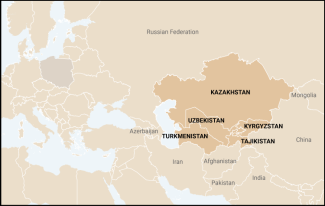
The Central Asian states are governed by authoritarian regimes, a factor that has traditionally aligned them with Russia and China and significantly limited their cooperation with the West. Over recent decades, these systems have proved relatively stable and currently face no viable political alternative, although they remain vulnerable to socio-political unrest. They actively seek new models of economic development and the resources needed to support them, while pursuing multi-vector foreign policies. At the same time, they strive to balance and manoeuvre between the main external actors without antagonising them and make limited efforts to diversify their foreign relations.
The region is undergoing a period of profound transformation. This stems partly from internal political and social dynamics and, in the international dimension, primarily from the consequences of Russia’s full-scale invasion of Ukraine. The war has called into question not only the sovereignty, territorial integrity and statehood of the country under attack, but also, implicitly, those of the other republics that emerged from the collapse of the Soviet Union. Russia’s openly neo-imperial policies have made it an almost existential threat to Central Asia as well, with Kazakhstan particularly exposed.
The war has increased the region’s importance – primarily for the EU and, to a lesser extent, for China – as an alternative to Russia both as a source of raw materials and as a transport corridor. It has also highlighted the risks that any destabilisation of Central Asia or its effective subordination to Moscow would pose to the EU’s efforts to diversify its supply chains. The heightened sense of threat, coupled with Russia’s entanglement in the war in Ukraine, has prompted a profound reassessment and renewed activism on the part of both the Central Asian states and the external actors engaged in this part of the world.
The common denominator of the policies towards the region pursued by major external powers – including China, Turkey and the EU – is support for the long-term viability of the Central Asian states, including their sovereignty and territorial integrity, as well as their resilience and autonomy, alongside the intensive development of political dialogue needed to deepen economic cooperation with them. China has taken the lead in this process, drawing in part on instruments such as the Shanghai Cooperation Organisation (SCO). Above all, Beijing’s stance has limited the risk of destabilising action by Russia in Central Asia, while also helping to protect and advance Chinese economic interests in the region, particularly in transport and energy. Turkey has actively promoted cooperation within the Organisation of Turkic States, with strong economic (including transport) and political components. The countries of East Asia and the Gulf have focused primarily on economic issues, with an emphasis on cooperation in raw materials and investment in modernisation. Promoting cooperation among the Central Asian states and strengthening their regional policies have been important aspects of the activities of all external actors. Russia has retained a significant portion of its political and economic instruments of influence in the region, but its ability to shape developments and strengthen its own position has been largely offset by the actions of other actors.
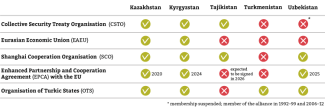
The Central Asian states have responded actively and assertively to the challenges and opportunities created by the war in Ukraine. They regard Russia as a threat – a direct one in Kazakhstan’s case, as noted above – and have limited political cooperation with it. They have refrained from providing political or military support to Russia in its role as an aggressor, resulting in the effective paralysis of the Collective Security Treaty Organisation (CSTO). Economic ties have deepened following the imposition of sanctions, but remain carefully managed. For example, Kazakhstan and Uzbekistan have rejected Russia’s proposal for a ‘gas alliance’ and blocked its attempts to take control of their gas transit infrastructure. At the same time, the shift in the attitude of local elites towards Russia does not signify a willingness to sever ties completely or engage in open confrontation with it.
The heightened interest shown by external actors should be viewed as highly beneficial for the region, as it is likely to increase stability and accelerate economic development both in the short term and, potentially, in strategic terms. The current situation appears to be a textbook example of Central Asia’s traditional multi-vector policy aimed at strengthening its own position through the active, relatively balanced and pragmatic development of relations with several partners simultaneously, including Russia as an indispensable and significant component of the regional balance.
Another highly significant development is the growing integration of the region, reflected in the increasingly close coordination among all five states in their dealings with external powers through the Central Asia Plus (C5+) format, in the normalisation of relations with Afghanistan and in cooperation on internal issues. Examples of the latter include the final resolution of the Tajikistan-Kyrgyzstan border conflict in 2025, which brought such disputes in Central Asia to an end, the gradual development of transport connectivity and closer cooperation over the management of water resources.
Four years on, the processes unfolding in the region are still under way, and a new model of regional order has yet to crystallise. As these changes remain fragile, they could be halted or reversed under unfavourable conditions, such as those that could arise from a Russian victory in Ukraine, although a return to the status quo ante bellum in relations between the Central Asian states and Russia appears impossible.
Table 1. Membership of the Central Asian states in selected international organisations and agreements.
1.2. Central Asia in EU policy
Russia’s full-scale invasion of Ukraine has lent new weight to the stated objectives of the EU’s policy towards Central Asia, which include supporting the region’s stability and development and expanding cooperation. Politically, Brussels has also emphasised the importance of strengthening resilience vis-à-vis Moscow and deepening dialogue with the region. Economically, Central Asia has gained importance as a source of energy resources and as an independent transport corridor bypassing Russia.
The transition of the EU and the Central Asian states into a new phase of relations has been reflected in the launch of an intensive dialogue, resulting in a series of bilateral meetings – primarily involving Kazakhstan, Uzbekistan, France, Germany and Italy – and multilateral engagements, including the first-ever EU-Central Asia summit in 2025. Over the past three years, EU member states have also stepped up efforts to advance economic and social projects, including in education and labour migration. The common denominator of the EU’s actions is the aforementioned commitment to strengthening Central Asia’s resilience and stimulating its modernisation, while placing less emphasis on the democratisation of the region’s authoritarian systems as a precondition for political and economic cooperation. At the present stage, Brussels differs little in its outlook and approach to the region from other major actors, including China and Turkey, sharing an interest in preserving Central Asia’s stability and autonomy and in harnessing its economic potential. In practical terms, however, this also entails intense competition among these actors.
From the perspective of nearly four years of war, the EU continues to face several constraints:
- difficult access to the region: routes through the South Caucasus remain relatively expensive, while Azerbaijan’s assertiveness and Georgia’s political trajectory have generated additional challenges. At present, the bulk of Central Asia’s oil and a portion of its strategic raw materials continue to reach Europe via Russian territory;
- sluggishness, the lack of a broader strategic vision and the frequently declaratory nature of its plans;
- the time-consuming and costly nature of its projects;
- limited influence over the region in the political and security spheres.
1.3. Outlook
In recent years, developments surrounding Central Asia have been marked by contrasting trends. On the one hand, the region and its cooperation with the EU and its member states have benefited from an exceptionally favourable political and economic climate. This part of the continent and the individual countries located there, particularly Kazakhstan and Uzbekistan, have proved resilient to major internal turmoil and capable of creating and exploiting opportunities for development and cooperation with external actors. This trend is likely to continue, although such cooperation will be shaped primarily by the course of the war in Ukraine and China-US rivalry. It will also depend on the degree of stability in other regions, which affects the attractiveness of transport routes running through Central Asia, and on the global economic situation, including shifts in commodity markets, emerging technologies and other factors. It should be assumed that economic competition in the region will intensify over time, although China is likely to remain the frontrunner.
On the other hand, the Central Asian states remain particularly vulnerable to Russia’s neo-imperial policies, with Kazakhstan directly exposed. This threat would increase further should the conflict in Ukraine conclude on terms favourable to Moscow. In this scenario, Russia could intensify political pressure on the Central Asian states and, in an extreme case, also resort to military pressure. Moreover, it could exacerbate and exploit internal tensions within the region, potentially altering the balance of power between itself and China and significantly narrowing the political space available to other external actors.
Under the first of these scenarios, cooperation between the West, including Poland and the EU, and the region could develop rapidly, whereas the second would minimise the opportunities and potential gains available to all sides. However, neither scenario would see Central Asia become a priority region for Poland or Europe, nor would Western actors emerge as the principal partners for the countries of the region. In neither case should Brussels be assumed to possess either the political will or the capacity to play a leading role in the region.
1.4. Recommendations
Central Asia remains an area of consistent interest for Poland, although it has by no means been a priority. Poland’s greatest engagement in the region came during the 1990s and the 2000s, when it conducted intensive political dialogue and made limited efforts to deepen economic relations, including in the energy sector. Cooperation linked to Poland’s participation in NATO’s stabilisation mission in Afghanistan was also significant to some extent. The subsequent decline in Polish activity stemmed from a growing focus on regions that were geographically closer and strategically more important, the winding down of the military presence in Afghanistan and the relative stagnation in Central Asia during the 2010s, driven by factors such as the advanced age of the leaders of the region’s largest countries and political manoeuvring surrounding their succession. Today, opportunities exist for Poland to reinvigorate its engagement with the region, but Central Asia is unlikely to emerge as one of the principal areas of Polish foreign policy – and vice versa.
Under the current circumstances, it is advisable to support the positive trends unfolding in Central Asia, primarily by strengthening the resilience, sovereignty and autonomy of the countries of the region, as well as their capacity to pursue multi-vector policies, thereby partly limiting the influence of Russia and China. At least indirectly, and in line with Poland’s interests, the effectiveness of these processes helps uphold an order based on international law and acts as a barrier to Russia’s neo-imperial ambitions. It is in Poland’s interest to support the institutional, economic and social modernisation of the region, as this would enable Warsaw to harness Central Asia’s economic potential to expand trade and investment flows.
In pursuit of these objectives, the following steps are advisable:
- intensifying political contacts with the Central Asian states, particularly Kazakhstan and Uzbekistan, which possess the greatest potential and pursue the most active foreign policies. Expanding these contacts is essential both for accurately interpreting local dynamics and shaping areas of cooperation, and for effectively supporting Poland’s economic and investment presence. Should Poland decide to adopt a systemic and clearly defined approach to the region, establishing a C5+Poland format would merit consideration;
- revitalising Poland’s efforts to promote its economic presence in Central Asia and aligning them with the EU’s activities and instruments. Such steps should help strengthen Warsaw’s voice within the EU on issues related to cooperation with the region. To this end, Poland could also leverage the presence of a relatively large number of Polish diplomats who effectively represent the EU in the region;
- seeking synergies between Poland’s approach to Central Asia and the South Caucasus and the policies pursued by other EU member states, as well as by Turkey, the United States and other actors engaged in the region.
EU POLICY TOWARDS CENTRAL ASIA
The Joint Roadmap for Deepening Ties between the EU and Central Asia was adopted on 23 October 2023 by the foreign ministers of the EU and the countries of the region. The document is based on the conviction that further development of cooperation is needed to strengthen resilience, promote prosperity and ensure sustainable development in the region amid new challenges and opportunities arising from shifting international dynamics. The initiative rests on a commitment to the Charter of the United Nations, international law, sovereignty, independence and territorial integrity, as well as the rejection of the use of force in international disputes.
The plan defines five main areas of cooperation:
- Deepening political dialogue between the EU and the Central Asian states, including by upgrading the status of relations, holding regular meetings at all levels (from heads of state to expert working groups) and covering a broad range of issues, from cooperation in upholding international law to the rule of law and labour rights.
- Strengthening economic, trade and investment ties through steps such as mapping out areas for cooperation, improving the investment climate and promoting standards. Priority areas include high-technology and climate-neutral investments and cooperation to prevent the circumvention of EU sanctions. Particular emphasis is placed on using existing formats and developing new ones for dialogue at the political, business and expert levels, and for cooperation based on the EU’s agreements and programmes, alongside business forums and associations operating in various formats.
- Cooperation in the fields of energy, the climate-neutral economy and developing transport connectivity, based on the Global Gateway strategy and within the framework of the European Green Deal. Key priorities include advancing connectivity, strengthening cooperation on energy links and critical raw materials, developing climate-neutral energy, including hydrogen, modernising energy infrastructure and promoting sustainable development. Environmental protection and water resource management also remain important areas of cooperation.
- Shared security threats. This area includes border protection, the prevention of terrorism and drug trafficking, CBRN (chemical, biological, radiological and nuclear), hybrid and cyber threats. Afghanistan is regarded as a significant common challenge. The parties also committed to deepening cooperation through EU programmes, training initiatives, exchanges of experience and other mechanisms.
- People-to-people contacts and mobility. Cooperation in this field is to be pursued through existing EU programmes, expanded educational and scientific exchanges and the promotion of culture and tourism. The potential of the EU-Central Asia Civil Society Forum was also highlighted.
The Joint Declaration of the first EU-Central Asia summit was adopted by the presidents of the C5 countries and the Presidents of the European Commission and the European Council in Samarkand on 4 April 2025.
The document reaffirmed the foundational principles of EU-Central Asia cooperation and noted that the sides had elevated their relations to the level of a strategic partnership. While the declaration reiterated the objectives set out in the Joint Roadmap, it shifted the emphasis somewhat. The starting point is shared security challenges – in line with the earlier approach, with Afghanistan treated as a distinct issue – alongside cooperation aimed at ensuring compliance with EU sanctions and the development of political ties with the region, including through the Enhanced Partnership and Cooperation Agreements (EPCAs). In the economic sphere, emphasis is placed on promoting trade, cooperating in the field of critical raw materials and advancing connectivity. Further priorities include cooperation on environmental protection and water management, as well as efforts to promote the rule of law, human rights and fundamental freedoms. In this regard, the declaration underlines the importance of the EU-Central Asia Civil Society Forum as a key platform for dialogue.
Krzysztof Strachota
2. Authoritarian regimes ‘enlightened’ to varying degrees: the domestic situation
2.1. The starting point: a turn towards the past and ‘presidents for life’
Following the collapse of the Soviet Union, communist-era elites retained power across Central Asia. In Kazakhstan, Turkmenistan and Uzbekistan, the former first secretaries of the communist parties assumed the presidency, while in Tajikistan, which was engulfed in a civil war, a lower-ranking party official became president. In building their states, however, these leaders drew less on the Soviet period and more on earlier historical eras. The legitimacy of the new states was meant to rest on a purported continuity between models drawn from the distant past – such as the Kazakh Khanate, the empire of Timur or even that of Alexander the Great – and the present day. These narratives also served to legitimise the rulers themselves, portraying them as successors to great historical figures. School textbooks entrenched these versions of national history in the minds of successive generations of pupils and today these narratives are widely perceived as self-evident, reinforcing the identity of the titular nations and encouraging citizens to identify with the state.
From the outset, individual leaders also sought legitimacy through references to Islam, including by building mosques, celebrating religious holidays and undertaking pilgrimages to Mecca to perform the hajj. At the same time, however, they viewed the religion – more deeply rooted among the long-settled Tajiks and Uzbeks than among the descendants of nomadic peoples such as the Kazakhs, Kyrgyz and Turkmens – as a potential threat to their rule. For this reason, they sought to maintain full state control over religious life.
Authoritarian regimes emerged across the region, characterised by extremely strong presidential power and the absence of any genuine opposition. Opponents were subjected to repression, forced into exile and, in some cases, physically eliminated, including in relatively liberal Kazakhstan. The 2005 massacre in the Uzbek city of Andijan, during a violent crackdown on anti-government protests, officially claimed 187 lives, although unofficial estimates put the death toll as high as 1,500. In Tajikistan, the Islamic opposition operated legally under the agreements that ended the civil war, but the government gradually succeeded in weakening it, before ultimately banning it in 2015 and persecuting its activists. Against this backdrop, Kyrgyzstan stood out as an exception: the opposition operated legally and the country experienced three popular uprisings that drove sitting presidents from power, although this should be seen as a sign of state weakness. The country is currently ruled by its sixth president. Following the 2010 revolution, Kyrgyzstan began transitioning towards a parliamentary system, but supporters of a return to presidential rule prevailed in a 2021 referendum.
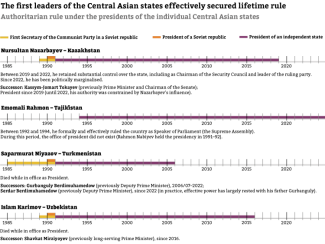
Having consolidated their hold on power, the region’s first leaders regularly initiated constitutional amendments that either ‘reset’ presidential terms or abolished term limits altogether, effectively enabling them to rule for life. In most cases, their power was constrained primarily by the interests of various pressure groups within the elite and to a far lesser extent by societal needs, a situation facilitated by the absence of any opposition. Islam Karimov, president of Uzbekistan from 1990 to 2016, died in office. His Kazakh counterpart, Nursultan Nazarbayev, held power from 1990 to 2019, when he stepped down but retained key levers of influence over the state. Following violent nationwide unrest in January 2022, his successor, Kassym-Jomart Tokayev, stripped him of all official positions, thereby dismantling the de facto dual power structure. A cult of personality developed in several countries, reaching its most extreme form in Turkmenistan during the presidency of Saparmurat Niyazov, who ruled from 1990 until his death in 2006.
2.2. The evolution continues: enlightened authoritarianism and cautious liberalisation
Among the ‘founding fathers’ of the Central Asian states, only Emomali Rahmon remains in power. Although he is formally the third president of Tajikistan – counting the sole president of the Tajik SSR – he has effectively ruled the country since 1992 and has largely shaped its contemporary character. In the region’s two key states – Kazakhstan, the largest, and Uzbekistan, the most populous – a generational shift at the highest level of power has already taken place. The new leaders, Kassym-Jomart Tokayev and Shavkat Mirziyoyev respectively, had worked closely with their predecessors (the former served as prime minister and speaker of the upper house of parliament, while the latter was a long-serving prime minister) and are no longer young themselves, having been born in 1953 and 1957 respectively. Nevertheless, after assuming power they introduced reforms aimed at modernising their countries and opening them up to the outside world.
In Kazakhstan, Nazarbayev had already introduced certain changes to the political system, aimed at correcting rather than radically reshaping it, particularly after the months-long workers’ protests in Zhanaozen in 2011, which were violently suppressed. Tokayev, for his part, carried out a far-reaching constitutional reform in 2022, designed to transform the country from a ‘super-presidential’ system into a presidential republic in which a strong parliament acts as a check on the power of the head of state. The reform was intended to improve governance and, in the longer term, strengthen Kazakh statehood. Tokayev, who must still contend with the hostility of his predecessor’s influential family, won an early presidential election in 2022, and the presidency has since been limited to a single seven-year term.
In Uzbekistan, an amended constitution allows Mirziyoyev to remain in power until 2037. He has sidelined Karimov’s inner circle and liberalised almost every sphere of life, most notably the economy, including by easing conditions for small businesses and foreign investors. At the same time, however, this process has unfolded within the framework of an authoritarian state: the president remains beyond any public criticism and the government maintains tight control over key sectors of the economy. Its response to the unrest that broke out in the autonomous region of Karakalpakstan in the summer of 2022, triggered by an attempt to curtail the region’s distinct legal status as part of constitutional reform, illustrates how the approach to internal challenges has changed since the Karimov era. Caught off guard by the scale of public discontent, the government resorted to force, resulting in more than a dozen deaths, but ultimately abandoned its plans and allocated additional financial resources to Karakalpakstan. Mirziyoyev’s achievements also include the normalisation of Uzbekistan’s relations with all its neighbours.
The political systems of Kazakhstan and Uzbekistan are well established and their institutions function effectively, despite underlying pathologies such as systemic corruption within the customs and tax authorities and the weakness of the judiciary. This efficiency has been facilitated by the presence of a well-educated workforce. In Kazakhstan, the Bolashak scholarship programme, operating since 1993, has played a key role, enabling more than 10,000 young people to study abroad, usually at leading Western universities. The role of informal family- and clan-based networks, characteristic of the 1990s and even the early 2000s, has gradually diminished. At the same time, these political systems require further reforms to adapt them to the changing situation in and around Central Asia and to strengthen their resilience against both external and internal challenges. One of the most serious of these is demographic pressure: Uzbekistan’s population alone continues to grow by around one million people each year, while the number of new jobs increases by only 600,000. In response, the state has developed a coherent policy on labour migration, supporting it at the central-government level. Another potential challenge facing the region is radical Islam: in the event of socio-economic shocks, local Muslim communities could become more active, a risk amplified by the ongoing bottom-up Islamisation of societies.
A threat to Tajikistan’s stability could arise during the transfer of power. Emomali Rahmon appears inclined to replicate the model seen in Turkmenistan, where power passed from father to son in 2022, and would like to hand over control of the state to his son Rustam during his lifetime while retaining influence over the system. This scenario could prove difficult to implement given the possibility of informal opposition to the new leader from Moscow and/or Beijing, as well as resistance from his nine siblings. Under these circumstances, interested parties could potentially foment unrest in the country. Their toolkit might include orchestrated strikes at industrial plants, protests in bazaars or the emergence of slogans calling for an Islamic revolution. It should be noted that none of the Central Asian states has developed effective and transparent mechanisms for the transfer of power, although experience suggests that the elites involved in the process are capable of reaching behind-the-scenes agreements and achieving consensus.
In Turkmenistan, limited liberalisation has benefited small and medium-sized enterprises, including those operating in the hotel, restaurant, catering and tourism sectors, by granting them somewhat greater freedom. The country has not experienced upheavals comparable to those seen in neighbouring states, making it difficult to predict how resilient it would prove to such shocks. Turkmenistan has been actively building influence in Afghanistan, for example by participating in infrastructure projects, partly in an effort to strengthen its own security.
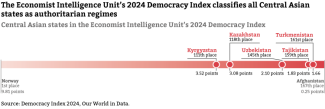
Kyrgyzstan, which for years faced the risk of a de facto split between its northern and southern parts, is now a relatively stable country – and certainly a more secure one following the resolution of its border disputes – although this progress has come at the cost of democratic backsliding and rising authoritarianism. As recently as 2015, the country ranked 93rd in the Economist Intelligence Unit’s Democracy Index, which classified its political system as a ‘hybrid regime’. The repressive nature of the regime in Bishkek has steadily increased, while new legal regulations modelled on Russian legislation have narrowed the space available to civil society.
2.3. A new chapter in relations with the West?
Russia’s invasion of Ukraine and the palpable threat posed by Moscow (the Kremlin has repeatedly questioned Kazakhstan’s borders, while fears also persist of possible Russian hybrid attacks) have acted as a catalyst for patriotic sentiment and intensified the decolonisation discourse taking place across Central Asia, albeit least prominently in Turkmenistan. At the same time, these factors have prompted the Central Asian states to open up more broadly to the outside world, including the West, in order to expand their room for manoeuvre, a process facilitated by the fact that they have undergone or are currently undergoing the internal evolution outlined above. Their visa policies may serve as a symbol of this process: just over a decade ago, citizens of the EU’s member states required visas to enter all five republics, whereas today only Turkmenistan maintains this requirement, although it has signalled that it could introduce electronic visas for tourists.
Europe and the United States have been active in the region since the collapse of the Soviet Union. Initially, in keeping with the prevailing spirit of the ‘end of history’ and the anticipated spread of democracy, they focused primarily on supporting civil society institutions, while also promoting the development of east-west transport corridors linking the post-Soviet south with Europe, notably through the TRACECA programme. Interest in the region rose again after 11 September 2001 and the subsequent US- and NATO-led military operation in Afghanistan, which required logistical bases in the country’s vicinity. On the one hand, Western capitals increased their support for the region’s secular autocrats, fearing that radical Islamists such as the Taliban could emerge as a viable alternative. On the other, they continued to press for democratisation and the promotion of human rights, notably by supporting the opposition during Kyrgyzstan’s Tulip Revolution in 2005 and by freezing contacts with Uzbekistan after the Andijan massacre. The decision to grant Kazakhstan the OSCE chairmanship in 2010 represented a vote of confidence for the region.
In the following years, cooperation between Europe and the United States on the one hand and the individual Central Asian states on the other focused largely on implementing previously launched assistance programmes aimed at building effective states based on the free market and the rule of law. Renewed interest in Central Asia was first prompted by Mirziyoyev’s reforms in Uzbekistan, followed by the events of January 2022 in Kazakhstan and, most notably, Russia’s invasion of Ukraine. As was the case three decades earlier, this renewed engagement has focused on two main areas: strengthening institutions – and, consequently, the resilience of states – with democratisation issues carrying only symbolic weight, and developing economic relations with the West, particularly through the Middle Corridor transport route. The specific interests of individual European countries have also played an important role, for example France’s efforts to secure uranium supplies from the region.
2.4. Recommendations
The starting point for European and Polish policy should be to accept the political systems that have emerged in Kazakhstan and Uzbekistan as a de facto reality. Given their potential, these two countries are the most important partners for the EU’s member states, including Poland. At present, these systems should be regarded as having no viable alternative, and the EU lacks both the instruments and the political will to influence them effectively. At the same time, it is advisable to maintain a readiness to support the modernisation of each state across its various dimensions, including its administrative and institutional structures, and to promote the rule of law as part of a broader evolution of these systems in a direction considered desirable by both the countries of the region and Brussels. This should not entail abandoning support for pro-Western circles. Rather, this agenda should be kept separate from day-to-day pragmatic political and economic cooperation.
Any steps that support the independence of the Central Asian states and strengthen their resilience are highly desirable, as they serve the interests of both the EU/Poland and of the elites of these countries. Even if such measures do not lead to a deterioration in their relations with Russia or China, these states will benefit from an improved bargaining position and greater room for manoeuvre, thereby expanding opportunities for cooperation with Brussels/Warsaw. This would also reduce the region’s vulnerability to subversive activities of all kinds.
This objective is best pursued by strengthening the state institutions of Central Asia’s priority partners through twinning programmes, which involve sharing Western experience and best practices in specific areas, and through inter-institutional and interministerial cooperation. Education also remains an important component of these efforts. Many of the issues outlined above are examined in greater detail in the subsequent chapters of this report.
Areas in which Poland could cooperate with Central Asian governments, including by leveraging EU instruments, encompass border protection, a broad range of infrastructure-related matters, such as transport and urban mobility, digital security solutions and public digital services such as the mObywatel app and the Pacjent.gov.pl website. Cooperation in these areas could involve both the transfer of know-how and support for Kazakhstan in sharing its own considerable experience with other partners, such as Kyrgyzstan.
Cooperation between Poland and the Central Asian states also appears promising in the field of memory politics. Uzbekistan was the first country in the region to openly address its colonial dependence on Russia. Following Russia’s invasion of Ukraine and the CSTO intervention in Kazakhstan that preceded it in 2022, post-colonial discourse, encouraged and supported by the government, has also gained renewed momentum in Kazakhstan, having previously been kept in check to avoid friction with Russia. Similar themes have also begun to emerge in public debate in Kyrgyzstan and Tajikistan.
Wojciech Górecki
II. SECURITY
1. Central Asia and regional security challenges
1.1. Overview of the regional security situation
Both Central Asian governments and external actors regard stability and security as one of the primary challenges. Concerns focus primarily on the internal stability of Central Asia, including the risk of social unrest stemming from socio-economic, political (including intra-elite struggles) and ethnic tensions, potentially drawing in external actors and affecting their interests. Over the past five years, every country in the region except Turkmenistan has experienced various forms of protest, many of which were violently suppressed.
Persistent concerns also relate to the risk of Islamic radicalisation and terrorism, reinforced by the proximity of Afghanistan. In the past, these fears centred on the country’s civil wars and the potential expansion of the Taliban; today, they focus primarily on the activities of Islamic State Khorasan Province. However, viewed against the backdrop of three decades of independence, these concerns appear overstated, as instability in the region has been largely confined to the Tajik civil war of the 1990s and a number of local, short-lived crises. Meanwhile, several broadly positive internal processes have been unfolding across Central Asia, generating considerable socio-political energy. These include demographic shifts and evolving identities, the ongoing restructuring and modernisation of the economies and the evolution of political systems within the framework of the prevailing authoritarian model – developments that have also created potential sources of tension.
For many years, another factor with the potential to destabilise the region was friction between its individual states, which at times risked escalating into open conflict. These tensions largely stemmed from disputes over borders, ethnic issues and water resources. In recent years, however, the only significant, localised conflict of this kind was the Kyrgyz-Tajik border dispute, which culminated in the 2022 clashes and has since been resolved by the countries concerned. From today’s perspective, the risk of intra-regional conflict can largely be regarded as a thing of the past.
Throughout the modern history of Central Asia, Russia has been the dominant security actor, maintaining extensive influence and a network of alliances, both multilateral – such as the CSTO, whose members include Kazakhstan, Kyrgyzstan and Tajikistan – and bilateral, notably with Uzbekistan, as well as informal leverage over neutral Turkmenistan. It has remained the region’s principal military partner, providing officer training, conducting joint exercises, supplying arms and maintaining military bases in Tajikistan and Kyrgyzstan, along with a permanent military presence in Kazakhstan.
Its unchallenged position in the field of hard security formed the foundation of the Kremlin’s influence and its claims to primacy in Central Asia. On the one hand, Russia helped stabilise the region and its regimes; on the other, it manufactured and exploited security challenges – whether internal or linked, for example, to Afghanistan – as instruments of discipline and control. In a characteristic example of the practical application of this approach, Russia and the CSTO intervened militarily during the crisis in Kazakhstan in January 2022, swiftly suppressing the bloody nationwide protests, which were closely intertwined with a power struggle within the ruling elite. This remains the only operational deployment of CSTO forces in the organisation’s history.
Map 2. Foreign military bases in Central Asia
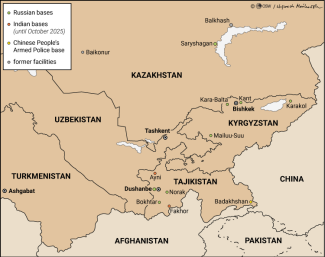
In recent years, China’s role in regional security has steadily increased, reflecting both its core interests – including stability in Xinjiang and, increasingly, the security of its investments – and the rapid growth of its economic power and global influence. China has pursued its vision of regional order in Central Asia, centred on unconditional stability and the neutralisation of US influence, primarily through political means, including cooperation with the Central Asian states, strategic dialogue with Russia and efforts to shape the agenda of the Shanghai Cooperation Organisation (SCO).
Military cooperation in the strict sense includes training programmes and exercises with the Central Asian republics, the provision of military equipment and, in exceptional cases, the establishment of Chinese military bases. Such facilities have been created in Tajikistan, primarily to protect Xinjiang from infiltration originating in Afghanistan. To safeguard its interests, China has also relied on private military companies, which have the strongest presence in Kyrgyzstan. To date, however, Beijing has neither displayed the willingness nor demonstrated the capability to respond militarily to crises in the region. In the past, in close connection with operations conducted in Afghanistan, the United States, other NATO members, India and several other countries maintained a military presence in the region. From the 1990s onwards, they operated and expanded facilities including air bases in Tajikistan, which remained in limited use until 2025. Despite these developments and potential future challenges, Central Asia has been a relatively stable region in global terms over the past two decades.
1.2. Challenges to regional security
Russia’s full-scale invasion of Ukraine emerged as the principal catalyst for change in the regional security order, coming just six months after the Taliban’s takeover of Afghanistan in 2021. Central Asia viewed the full-scale invasion of the strongest post-Soviet republic outside Russia itself as unprecedented, both in terms of the scale of violence employed in an unprovoked conflict and Moscow’s willingness to challenge the very foundations of other countries’ sovereignty and territorial integrity. At the same time, despite devoting considerable attention and resources to the protracted war, the Kremlin has yet to achieve its core objectives, exposing its military and political limitations. As a result, the conflict has accelerated the erosion of Russia’s position in Central Asia, as reflected in its inability to secure support from the CSTO, the need to redeploy personnel from the 201st Military Base in Tajikistan to reinforce the front in Ukraine, and a reduction in arms sales to the Central Asian states.
The new circumstances and challenges have prompted the Central Asian republics to thoroughly reassess their security policies. First and foremost, they have distanced themselves from Russia in the context of its invasion of Ukraine, while avoiding open confrontation, maintaining dialogue and demonstrating a willingness to make positive gestures, such as participating in Victory Day celebrations in Moscow. At the same time, they have taken steps to strengthen their autonomy and resilience at the regional level. Notably, they have undertaken independent, regionally coordinated efforts to address ongoing security challenges, as demonstrated by the normalisation of relations and cooperation with the Taliban and the resolution of the Tajik-Kyrgyz border conflict. Moreover, the region has been actively seeking security partners beyond Russia while enhancing its own defence capabilities and exploring opportunities to deepen military ties, including through training programmes and arms procurement, in both bilateral and multilateral formats, primarily with Turkey and within the framework of cooperation among Turkic states.
Russia’s neo-imperial course remains a constant feature of its policy, and Central Asia appears a likely target for renewed Russian expansion should the war in Ukraine be frozen or concluded on terms favourable to the Kremlin, freeing up the resources and attention currently devoted to the conflict. Russia is likely to exert pressure on the Central Asian states primarily through hybrid activities, including by generating and exacerbating socio-political tensions and associated frictions within the ruling elites, for example in the context of the forthcoming succession of power in Tajikistan. If Moscow skilfully harnesses and exploits social discontent, such frictions may escalate into open confrontations between competing interest groups.
There is also a significant risk that Moscow could amplify and instrumentalise threats associated with terrorism and Islamic radicalism, whether by exploiting the presence of Central Asian migrants in Russia (for example through selective deportations) or by leveraging the threat posed by Islamic State Khorasan Province in Afghanistan, which ranges from isolated terrorist attacks to hypothetical incursions into the border regions of the Central Asian states. Such actions could provide Russia with a pretext for military intervention in the region.
A particularly sensitive situation exists in and around Kazakhstan. As the only Central Asian republic that borders Russia and faces a direct threat from it, Kazakhstan has been periodically targeted by Russian politicians and media outlets questioning its statehood and territorial integrity. The country is also home to a sizeable ethnic Russian minority – comprising around 15% of the population overall and more than 40% in some northern oblasts, including Kostanay, East Kazakhstan and North Kazakhstan – creating favourable conditions for Russian hybrid activities.
An intensification of such operations, a direct Russian military intervention in the region or serious internal unrest in one of the Central Asian states resulting from Moscow’s actions would likely destabilise the region and prompt countermeasures from other external actors, primarily China and Turkey.
1.3. Central Asian security in Western policy
Maintaining regional balance and, since 2022, safeguarding the sovereignty and territorial integrity of the Central Asian states have been among the stated priorities of both the EU and the United States. At the same time, with the exception of a brief period of military cooperation during the US- and NATO-led operations in Afghanistan (2001–21, with the closest cooperation occurring in the early years of that period), the West has neither played a significant role in regional security nor aspired to do so. Instead, it has focused on soft-security issues, including combating terrorism, countering drug trafficking and enhancing border security, as well as on cooperation with institutions dedicated to addressing these threats. At the political level, emphasis has been placed on promoting democracy and human rights, which are regarded as prerequisites for improving internal security.
Despite all the self-imposed constraints adopted by NATO, Washington, Brussels and the Central Asian states themselves, debate on security issues has continued at both the multilateral and bilateral levels, particularly since 2022. This includes formats such as the High-Level Security and Political Dialogue between the EU and the Central Asian states. One permanent feature of cooperation in this area is military training and joint exercises involving the armed forces of the countries of the region, the United States (through the National Guard units of individual US states) and selected EU member states, primarily France and Italy. This cooperation focuses mainly on crisis management and soft-security challenges, helping to build contacts and improve the West’s situational awareness, while also facilitating arms sales.
The technical modernisation of the region’s armed forces is emerging as an increasingly important area of cooperation. Russia has traditionally been the key supplier of weapons and military equipment to Central Asia, particularly to its largest countries, Kazakhstan and Uzbekistan. However, the role of China, Turkey and European countries in this field has been growing. Among the latter, France, Italy and Spain are the principal suppliers of military equipment to Central Asia, mainly transport and training aircraft, helicopters, radar and communications systems, drones and naval equipment. The share of Western defence companies in the Central Asian market has increased in recent years, owing both to the war in Ukraine, which has reduced the availability of Russian weapons and encouraged the diversification of arms procurement, and to the relatively high value of European-made equipment, such as transport aircraft.
Turkey occupies a unique position in the regional security landscape. It has pursued a policy independent of Europe and the United States but broadly aligned with their strategic objectives, such as strengthening the resilience and agency of the Central Asian states and promoting stability. Turkey ranks among the leading suppliers of arms and military equipment to most Central Asian republics, organises and participates in military training programmes, including within the framework of cooperation among Turkic states, and continues to expand intelligence cooperation across the region.
In the future, the emerging security landscape may be significantly shaped by the intensifying global rivalry between China and the United States, which could increase Washington’s interest in the region. This trend was already evident after the US established bases in Central Asia following the 11 September terrorist attacks and has resurfaced during Donald Trump’s second term, notably through his pressure on the Taliban to reopen a US base in Afghanistan. Against this backdrop, it is reasonable to expect renewed US engagement in the region, alongside Chinese efforts to forestall this outcome.
1.4. Recommendations
Europe, including Poland, is not and is unlikely to become a major actor in shaping the hard-security environment of Central Asia, as it lacks both the political will and the resources commensurate with the challenges involved. As a result, its direct influence on the most important developments in this sphere, including any future conflicts, will remain limited.
Politics and diplomacy remain the primary tools of engagement in the security sphere. It is desirable to further support the sovereignty, agency and resilience of the individual Central Asian states through close dialogue with regional partners, particularly Kazakhstan and Uzbekistan. It also appears worthwhile to seek synergies among the efforts of European countries, including Turkey, and to pursue dialogue with non-Western actors interested in the stability of Central Asia, from Azerbaijan to the countries of the Global South, particularly the Asian members of the Shanghai Cooperation Organisation.
The unstable situation across the wider Middle East, particularly in Afghanistan and Iran, offers a promising avenue for security cooperation, as it may pose challenges for both Central Asia and the EU over the medium and long term. Although any potential threats are likely to fall primarily within the realm of soft security, they will nevertheless drive efforts to strengthen hard security.
Cooperation in the training and modernisation of the armed forces of the Central Asian republics should be maintained and further expanded, while remaining mindful of its limitations. In the short term, such efforts should foster closer political ties, generate potential economic benefits, help build expertise and support the development of lasting channels of cooperation and trust.
Krzysztof Strachota
2. Islamic radicalism and the drug route: overstated threats?
2.1. Islamic radicalism and terrorism in Central Asia
Concerns about the rise of Islamic radicalism – and, by extension, terrorism – have persisted in the region, with varying intensity, since the emergence of the independent states. Both the governments of the individual Central Asian states and external actors have raised, and continue to raise, this issue. The former are concerned about the threats that Islamic radicalism and terrorism pose to internal stability, while also using them as a pretext to suppress opposition. The latter either fear the long-term destabilisation of Central Asia or seek to exploit this ‘threat’ to advance their own interests. Initially, these concerns stemmed from the activity of homegrown Islamist movements, which were particularly strong in the early 1990s, and the perceived risk of expansion by groups based in Afghanistan and the Middle East, including the Taliban, Al-Qaeda and Islamic State. Over time, attention increasingly turned to the activities of Central Asian radicals outside the region, including in Afghanistan, Pakistan, Russia, Europe and Turkey.
Fears that Islamist extremists could seize power in the Central Asian republics were most acute in the 1990s. Such attempts were made in Uzbekistan and, above all, during the Tajik civil war (1992–97). In the realm of propaganda, the issue resurfaced during the Arab Spring in 2011. The fight against radicalism also provided a convenient pretext for banning Tajikistan’s main opposition party, the Islamic Renaissance Party of Tajikistan, in 2015. The perceived threat from Afghanistan, a country regarded either as a base for or a driver of radicalisation and terrorism in Central Asia, was particularly pronounced at the turn of the 21st century, notably during the incursions of the Islamic Movement of Uzbekistan into Kyrgyzstan and Uzbekistan in 1999 and 2000. This anxiety re-emerged sporadically thereafter, particularly following the Taliban’s takeover in 2021. For example, the government of Kazakhstan accused radicals from Afghanistan of participating en masse in the protests that were violently suppressed in January 2022. Central Asia has also experienced terrorist attacks, although these have been limited in scale. The perceived threat of Islamic radicalism fostered a sense of dependence on Russia, which used this threat both to justify its robust military and security presence in the region and to portray the fight against it as an area of shared interests and cooperation with the West.
Fears of the region’s radicalisation have proved overstated, while the threat itself has been substantially mitigated, partly as a result of the harsh measures employed by the authoritarian Central Asian regimes. While the role of Islam as a key source of identity is clearly growing, and Salafism – a radical reform movement within Islam that advocates religious renewal through a return to the faith’s roots and serves as the ideological basis for most Sunni extremist political movements – has been gaining ground in isolated pockets in its apolitical form, these developments do not provide grounds for serious concern. The possibility of future Islamic radicalisation and the politicisation of Islam in Central Asia cannot be ruled out, although this scenario is likely to materialise only in the event of a profound breakdown of the political order in the region, combined with a sharp deterioration in the international environment and the instrumentalisation of this issue by external actors. For example, Russia could use such developments as a pretext to expand its presence in the region.
A second dimension of Islamic radicalism in Central Asia is the involvement of its residents in armed and terrorist activities beyond the region’s borders. This is notably reflected in the emergence of autonomous extremist organisations such as the Islamic Movement of Uzbekistan and the Islamic Jihad Union, both of which fought against US and NATO forces in Afghanistan and against the Pakistani government, primarily during the 2000s. A relatively large number of Central Asian jihadists (around 5,000) joined Islamic State in Syria and Iraq during the group’s period of expansion. Some of those volunteers subsequently entered the ranks of the Syrian armed forces following the fall of Bashar al-Assad’s regime in 2024. From the perspective of the Central Asian governments, this outflow produced largely positive effects by removing actual and potential radicals from the region, redirecting their activities to other countries and increasing the likelihood of their gradual elimination abroad. At the same time, however, Western forces engaged them in direct combat during military operations in countries such as Afghanistan, Iraq and Syria.
A third dimension of the problem is the genuine, albeit limited, terrorist activity of extremists originating from Central Asia in Europe, the United States, Turkey and Russia. This phenomenon remains a marginal aspect of the broader process of radicalisation affecting immigrant and other communities and is a by-product of the activities of terrorist organisations operating within them. In such cases, radicalisation takes place outside Central Asia, primarily among labour migrants in Russia. This process is facilitated by the absence of established social controls, much easier access to extremist content and a sense of alienation and discrimination experienced at the hands of both the government and citizens of the host country.
Table 2. Terrorist attacks involving Central Asian extremists carried out or foiled in Europe and the United States
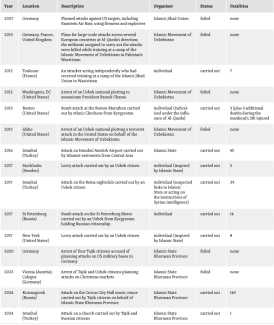
In recent years, Islamic State Khorasan Province has embodied all three dimensions of the threat. Based in Afghanistan, it has been actively engaged in the conflict there as the Taliban’s principal adversary. The organisation has the capacity to conduct operations in Central Asia and has been recruiting and training militants and carrying out terrorist activities on a transregional scale.
2.2. On the drug route
Alongside Islamic radicalism and terrorism, another major soft-security challenge is Central Asia’s role in the global drug trade. This problem stems from the region’s proximity to Afghanistan, the world’s leading producer of opiates over recent decades. One of the principal trafficking routes for Afghan narcotics – the so-called Northern Route – passes through the Central Asian republics into Russia and onwards to destinations including Europe. Other major routes include the Balkan Route through Iran and Turkey, the Caucasus Route through Iran and the Southern Route through Pakistan. According to UN estimates, at its peak in 2000 the Northern Route accounted for the transit of approximately 65% of Afghan opiates.
Although narcotics continue to be trafficked through Central Asia – and, to a lesser extent, produced there – its importance as a transit route to Europe has steadily declined, partly as a result of broader global shifts. As early as 2010, the region’s share of the transit of Afghan opiates had fallen to 25%, with flows increasingly redirected through Iran (via the overland Balkan Route and Caucasus Route to Europe) and Pakistan (via maritime routes to global markets). In recent years, this trend has only intensified, largely driven by tighter controls along the Polish-Belarusian border and the borders between the Baltic states and Russia and Belarus after 2021, while smuggling through Ukraine has effectively ceased following Russia’s full-scale invasion in 2022.
Another factor constraining this trade is the ban on poppy cultivation introduced by the Taliban in 2022, although the precise impact of this measure remains difficult to assess. Within a year of taking power in Afghanistan, the Taliban had eradicated 95% of the country’s poppy fields, resulting in a sharp drop in supply (partly reflected in lower volumes of drug seizures) and a corresponding rise in prices. However, the situation remains fluid. Existing stockpiles have not been fully eliminated, while production has begun to recover in parts of the country’s north-eastern provinces bordering the Central Asian states, leading to a temporary increase in the volume of intercepted opiates.
Global trends are also increasingly shaping developments. Afghanistan and the wider region are producing increasing quantities of synthetic drugs, particularly methamphetamine and new psychoactive substances (NPS). According to data from the European Union Drugs Agency (EUDA), the main sources of narcotics reaching the EU are South America, West Asia, South Asia and North Africa. Heroin is imported primarily by sea through ports in Turkey and the United Arab Emirates. Taken together, these developments indicate that Central Asia is playing an increasingly marginal role in drug trafficking to Europe.
2.3. The European Union and soft security threats
At the declaratory level, cooperation with the Central Asian republics in addressing the threat of Islamic radicalisation and terrorism remains an important objective of the EU’s policy towards the region. At the same time, practical cooperation has been fundamentally constrained by differing perceptions of the nature of the problem. The EU has sought to address the issue by strengthening state resilience and modernising and liberalising political and socio-economic systems. It regards many of the steps taken by the Central Asian governments, including repressive measures, as counterproductive, arguing that they instrumentalise the threat and effectively reinforce authoritarianism.
In contrast, border security, including efforts to combat organised crime and drug trafficking through Central Asia, has been an area of genuine cooperation. The military involvement of NATO’s European members in the International Security Assistance Force (ISAF) and the Resolute Support Mission (RSM) in Afghanistan following the 11 September 2001 terrorist attacks made a particularly important contribution in this regard. Building on this engagement, in 2003 the EU launched the Border Management Programme in Central Asia (BOMCA) and the Central Asia Drug Action Programme (CADAP), allocating €61.8 million and €32.4 million respectively to their implementation between 2003 and 2025.
2.4. Recommendations
While the challenges associated with radicalisation and the rise of Islamist terrorism in Central Asia are chronic, the experience of the past three decades suggests that they have been largely overstated. Their direct impact on the internal security of European countries has been very limited, while Europe’s ability to address these problems in Central Asia remains minimal. Developing channels of communication with the relevant institutions in the Central Asian republics responsible for these issues appears worthwhile. However, concrete measures to safeguard internal security are, and should be, undertaken within the EU itself and, when appropriate, in areas where Central Asian radicals have been active, such as Syria and Iraq. Under no circumstances should Russia be regarded as a partner in this field.
Any potential cooperation between Poland and the security services of the Central Asian republics on migration-related issues requires thorough consideration (see the chapter ‘Central Asia on the move’). From a pragmatic standpoint, such cooperation appears necessary in light of the growing presence of migrant workers and students from the region, as well as the need to develop optimal practical arrangements for information sharing, extradition and the prevention of extremist activity. At the same time, it is important to bear in mind the risk that the governments of individual Central Asian states could instrumentalise these measures to intimidate and persecute political opponents under the pretext of combating radicalism in Poland.
Maintaining and further developing cooperation in the areas covered by the BOMCA and CADAP programmes appears warranted. These initiatives should be viewed as a means of strengthening the region’s broader institutional capacity and as a platform for developing contacts and exchanging experience. It is also desirable to expand dialogue with the Central Asian states – and potentially increase targeted assistance – to address the challenges emanating from Afghanistan, which remains closely associated with the threats of terrorism and drug trafficking. Since the Taliban took power there, the Central Asian states have developed an extensive and pragmatic framework for political, economic and social cooperation with the Taliban authorities, along with a formula for dialogue that has so far proved effective in minimising security risks. In doing so, they have strengthened their capacity to act as intermediaries on issues relating to Afghanistan.
Józef Lang, Krzysztof Strachota
III. ECONOMY
1. In search of a new development model
The Central Asian states differ in size, wealth (including natural resource endowments), geographic location, the degree of openness to international cooperation and the quality of the investment climate. At the same time, their economies share a number of common features. Natural resources, including oil, gas and uranium (particularly in Kazakhstan, Turkmenistan and Uzbekistan), aluminium (in Tajikistan) and gold (in Kyrgyzstan) play a central role, as do transport and logistics (Kazakhstan and, to a lesser extent, Uzbekistan are key links in the Middle Corridor) and agriculture (including cotton cultivation in Uzbekistan, Turkmenistan and Tajikistan; the sector is important both for local societies and for international cooperation, including with Poland). Moreover, labour migration and the income it generates remain significant for the economies of Uzbekistan, Kyrgyzstan and Tajikistan. The services sector, including IT and tourism, is gradually gaining importance across the region. Together with the broader digital economy, it is expected to drive the diversification of the Central Asian economies, which remain overly dependent on resource revenues, and to enhance the region’s resilience to external shocks.
Map 3. Economic profile of the Central Asian states
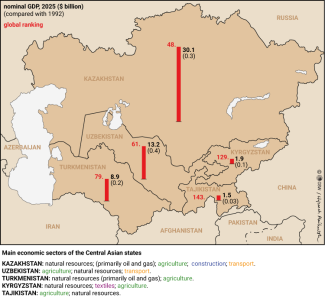
Source: authors’ own compilation based on 2025 data from the International Monetary Fund and official government data from the individual Central Asian states.
The deepening cooperation among the five Central Asian states, a trend particularly evident in recent years, is crucial for the region’s economic future. This process has been largely driven by the continued development of infrastructure and transport networks. It is fostering the growth of a large, still-expanding and increasingly integrated market of around 80 million people. Greater cooperation can also facilitate more effective management of key shared challenges. These include, on the one hand, the region’s landlocked location far from the world’s oceans and its increasingly constrained access to water as a result of advancing climate change. On the other, they involve complex economic and political dependencies on neighbouring powers, primarily Russia and China. Relations with these two countries generate both risks and opportunities for the Central Asian states. The latter relate to the development of their increasingly energy-intensive economies and the prospect of participating in attractive transport and energy projects, such as importing inexpensive commodities (including natural gas) from Russia, constructing nuclear power plants with Rosatom and developing transport infrastructure with Chinese financing. In addition, Tajikistan, Kyrgyzstan and Uzbekistan remain dependent on the Russian labour market and on remittances from migrant workers.
After regaining independence, the Central Asian states, with the exception of Kazakhstan, maintained relatively few trade links, leaving them vulnerable to shocks stemming from economic cycles, exchange-rate fluctuations and the policies of their key partners. Their political and economic orientation towards Moscow or Beijing hindered their ties with global markets and intraregional trade and economic integration. Until 2022, Kazakhstan was the only country in the region to rank among the major trading partners of each of the other four republics. However, this situation gradually began to change: the years 2022–24 saw record levels of both intraregional trade and foreign direct investment (FDI).
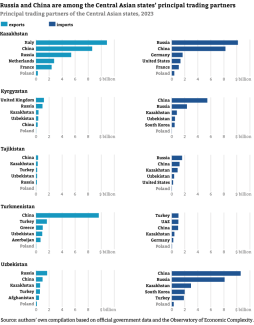
Kazakhstan is the economic leader of Central Asia. One factor enhancing the security of investments in the country is the Astana International Financial Centre (AIFC), which operates under English common law and supports foreign businesses in a number of ways, including by facilitating tax residency and assisting with the management of investment funds. Uzbekistan is in the midst of reforms that are partially liberalising its economy and offers considerable growth potential driven by the development of small and medium-sized enterprises and supported by its sizeable domestic market. Turkmenistan grapples with an undiversified export structure and dependence on a single trading partner, China, whereas Kyrgyzstan and Tajikistan remain relatively small economies.
1.1. The current state and potential of trade relations with the EU
The European Union is well placed to exert significant economic influence in Central Asia. It is the region’s second-largest trading partner after China and ahead of Russia, with total trade exceeding €55 billion in 2024. Central Asian exports to the EU include energy resources (primarily crude oil from Kazakhstan), metals and minerals (including uranium, gold and aluminium), agricultural products (such as cotton and fruit from Uzbekistan) and textiles. Imports from the EU consist primarily of machinery and equipment, chemicals, vehicles and manufactured goods.
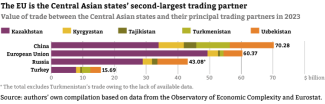
Trade relations between EU member states and the Central Asian republics are characterised by asymmetries in both economic potential and relative importance. The EU is the region’s largest investor, with its cumulative FDI stock standing at approximately $280 billion, or around 40% of all foreign direct investment in Central Asia, much of which is concentrated in Kazakhstan’s extractive sector. The EU is also a major provider of development assistance to the region. Among its member states, the largest investors in Central Asia are the Netherlands ($67 billion, invested in Kazakhstan), France ($20 billion), Italy ($7.6 billion), Germany ($6.7 billion) and Luxembourg ($2.9 billion).
For the region – led by Kazakhstan, which accounted for more than 84% of its trade with the EU by value in 2024 – this cooperation is very important. For the EU, by contrast, the Central Asian states, with the notable exception of Kazakhstan, remain marginal partners when viewed solely through the prism of bilateral trade. This assessment holds true despite the growth in trade recorded between 2022 and 2024.
Kazakhstan is also Poland’s principal trading partner in Central Asia, with bilateral trade reaching $1.76 billion in 2024, far exceeding Poland’s combined trade with the other four Central Asian republics ($759.35 million). Polish-Kazakh cooperation appears particularly promising in the extractive, agri-industrial and advanced technology sectors. At the same time, several factors may discourage Polish companies from investing in the region, including the widespread perception of its instability, the limited size of consumer markets in Tajikistan, Kyrgyzstan and Turkmenistan, and the region’s ties to Russia.
The importance of the Central Asian states for the European Union stems from their potential in specific sectors, particularly raw materials, energy and transport. The significance of these areas of cooperation has been growing in the context of sanctions on Russia and the global competition for the resources essential for developing advanced industries and driving the transition to a low-emission economy (see the chapter ‘Hydrocarbons and critical raw materials: another chapter in the Great Game?’). The EU’s recognition of Central Asia’s potential in these sectors has translated into increased imports of crude oil, uranium and critical raw materials from the region since 2022. Prospects for expanded cooperation in areas of interest to EU member states are reflected in progress on agreements governing trade relations and facilitating the Central Asian republics’ access to the European market. In October 2025, the EU concluded an Enhanced Partnership and Cooperation Agreement (EPCA) with Uzbekistan, making it the third Central Asian state after Kazakhstan (2020) and Kyrgyzstan (June 2024) to have signed such an agreement. Negotiations on an EPCA with Tajikistan began in February 2023.
At the same time, the sharp increase in EU exports of certain categories of goods, such as vehicles, to Central Asia, particularly Kazakhstan and Kyrgyzstan, has raised concerns that they could be re-exported to Russia to circumvent sanctions.[1]
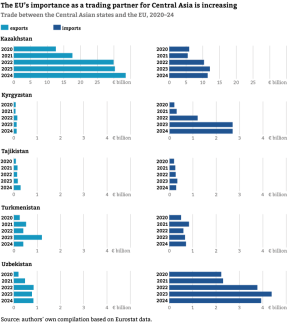
A turning point in economic relations between the EU and the Central Asian republics after February 2022 came with their inclusion in the EU’s Global Gateway strategy, launched in December 2021 to support investment projects in transport, digital and energy connectivity in line with the objectives of the European Green Deal. Under this framework, the EU established two Team Europe initiatives for Central Asia: one focusing on water, energy and climate, and the other on digital connectivity. The strategy was further reinforced at the first EU-Central Asia Summit in Samarkand in April 2025 with the adoption of an investment package allocating €6.4 billion to environmental projects, €3 billion to the Middle Corridor, €2.5 billion to projects for the exploration and extraction of critical raw materials and €100 million to satellite connectivity. These funds constitute an overall funding envelope to be deployed through a range of financing and lending instruments.
1.2. Opportunities, challenges and recommendations
The Central Asian states are searching for a new development model. The current one, based primarily on exports of energy resources and precious metals – particularly in the case of Kazakhstan, Turkmenistan and Uzbekistan – has done little to enhance the competitiveness of their economies, leaving them overly exposed to global economic volatility and providing limited impetus for modernisation. Although the extractive sector will remain critical, and energy resources, metals and other raw materials (such as uranium and gold) will continue to dominate exports, the Central Asian states are striving to expand the role of other sectors in order to make their economic development more sustainable. They are seeking to gain broader access to global markets and to develop transport corridors and logistics hubs. Accordingly, they have been looking to foreign partners to provide capital and added value in the form of expertise and technology transfer, even if limited. This creates opportunities for the EU and its member states to deepen economic ties with the region.
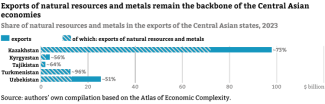
At the same time, it should be recognised that the favourable conditions for economic cooperation between the EU member states, including Poland, and Central Asia will face numerous challenges, including those stemming from domestic political factors, particularly the risk of authoritarianism in the region intensifying to the point where it becomes impossible to conduct business under predictable conditions. Neither the EU nor its individual member states possess the instruments to exert significant influence over the internal dynamics of the Central Asian states. However, by far the greatest risk arises from their ties with Russia and China. The EU’s two most powerful competitors in this part of the world are likely to pursue a strategy designed to make the Central Asian economies as dependent on them as possible. China in particular possesses the capacity to expand its economic footprint in Central Asia to an extent that could eclipse what Europe has to offer.
Effective economic cooperation with the region requires combining business activity – at the level of companies, EU member states and the EU as a whole – with sustained political engagement with individual countries, as this is essential both for implementing projects and for determining their pace and scope. This approach should also draw on soft-power instruments, including those related to education, institutional capacity-building, development cooperation and environmental and climate action. It would also help advance the non-economic strategic objectives of the EU and its individual member states while aligning with the expectations of regional partners.
It is in the interest of both EU member states, including Poland, and the Central Asian states to diversify the latter’s external ties in areas such as infrastructure development, the removal of transport and trade barriers and the inflow of capital and investment from diverse sources. Such efforts would reduce the advantages enjoyed by Russia and China, while also expanding opportunities within the region to develop more sustainable models of economic growth and socio-economic development. Consequently, it is advisable to support bottom-up processes of integration and economic cooperation both within Central Asia and between the region and the outside world. EU member states should also explore opportunities to cooperate in this regard with other ‘smaller’ partners, such as Turkey, East Asian countries and the Gulf states.
Closer economic ties with Kazakhstan and Uzbekistan could present an opportunity, particularly for Poland, to establish a broader presence in the region over time. These two countries are the economic leaders of Central Asia, endowed with abundant natural resources. They also offer foreign investors preferential conditions in special economic zones and opportunities to concentrate investments in sectoral clusters, such as technology clusters. Cooperation with Turkmenistan also holds long-term potential, primarily owing to its resource base, but implementing projects in this country would require greater economic openness to the outside world.
Agata Łoskot-Strachota, Karol Wasilewski, with contributions from Daria Zielińska
2. Hydrocarbons and critical raw materials: another chapter in the Great Game?
2.1. Resources and international links of the Central Asian states
Central Asia’s key energy resources are crude oil, natural gas and uranium. It also holds deposits of numerous critical raw materials, including rare earth elements. The region benefits from favourable natural conditions for generating renewable energy, particularly solar and wind power, and for harnessing it to produce clean energy carriers such as hydrogen.
Kazakhstan holds the largest proven oil reserves in Central Asia and the world’s twelfth largest (Energy Institute, 2024), with Turkmenistan and Uzbekistan ranking further down the list. In 2022, Kazakhstan was the world’s thirteenth-largest producer of crude oil and tenth-largest exporter. Turkmenistan holds the largest natural gas reserves in Central Asia and the world’s fourth largest, while Kazakhstan and Uzbekistan also possess substantial reserves. Regional gas production has increased over the past decade, primarily in Turkmenistan, which is also the world’s ninth-largest exporter of natural gas (Energy Information Administration, 2023).
Map 4. Reserves of key energy resources and critical raw materials in Central Asia and their share of global reserves.
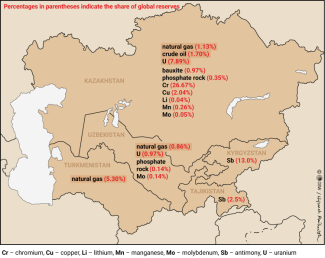
Source: Oil&Gas Journal Research Centre; Uranium 2024: Resources, Production and Demand (IAEA/NEA); Mineral Commodity Summaries 2024 and 2025 (USGS).
The region is home to substantial uranium reserves. Kazakhstan is the world’s largest producer of uranium, while Uzbekistan ranks fifth. Central Asia also holds documented reserves of around 20 critical raw materials, including manganese, chromium, titanium, bauxite/aluminium, copper, cobalt and molybdenum. Moreover, it also holds reserves of rare earth elements, including cerium, lanthanum, neodymium and yttrium (see map), alongside globally significant deposits of lead (20% of world reserves) and zinc (12.6%).
Kazakhstan holds the region’s largest deposits of critical raw materials and currently extracts 17 minerals classified as critical by the United States and 19 included on the EU list. The country ranks second globally in chromium production and is among the world’s top ten producers of cadmium, selenium, bauxite, zinc, tellurium and manganese. Other Central Asian republics also possess significant potential in the field of critical raw materials. Uzbekistan is home to the region’s largest titanium deposits, while Tajikistan holds the largest reserves of antimony, the latter also being found in Kyrgyzstan.
Owing to historical factors, Russia continues to play a critical role in a number of strategic aspects of the energy sectors of the Central Asian states. It holds the largest share of any external actor in Kazakhstan’s nuclear sector and retains considerable influence over, and de facto control of, the export routes for most of the country’s oil. It also controls strategic gas assets in Uzbekistan, including the country’s largest gas storage facility. However, in oil extraction, particularly in Kazakhstan, Russian companies have gradually ceded ground to US and European firms since the 1990s. Over the past three decades, Russia’s importance in the region’s raw material and energy markets has declined, transforming it from the dominant player into one of several actors operating in the region. This shift has been driven by the diversification of export routes and markets for gas, oil and uranium, as well as the entry of non-Russian investors into Central Asia’s extractive and energy sectors. These trends have been particularly evident in Kazakhstan’s oil industry, where Western companies have played an important role not only in extraction but also in efforts to diversify export routes. As Western engagement has gradually diminished, China’s role has expanded, primarily in Turkmenistan’s natural gas sector.
Following Russia’s full-scale invasion of Ukraine, Central Asia – particularly Kazakhstan, Turkmenistan and Uzbekistan – showed growing interest in cooperation with the EU in the fields of energy resources and, even more so, critical raw materials. This stemmed not only from the substantial financial and technological needs associated with exploration, the launch or expansion of production and the development of the infrastructure required for exports, but also from the fact that expanding the region’s critical raw materials sector would, to some extent, place it in competition with China and Russia. China is already the largest player in Central Asia’s critical raw materials sector, importing around 70% of the region’s output in 2024. At the same time, developing these resources would allow the Central Asian economies to diversify their sources of income and reduce their dependence on volatile oil and gas markets, while cooperation with the West could also help them lessen their reliance on ties with Russia and China.
The rapid curtailment of access to the EU market for Russian raw materials and fuels after February 2022 has increased Moscow’s interest in energy cooperation with Central Asia in recent years. The Kremlin has a strong interest in expanding its export markets, primarily for Russian natural gas, by increasing sales to the Central Asian states and thus at least partially offsetting the loss of export opportunities in Europe. Russia also seeks to secure access to Central Asian export routes to China and, ideally, gain control over them, as this would enable it to ship additional volumes of its own gas to the Chinese market without major investment in domestic infrastructure.
2.2. Opportunities and challenges
Geography is the principal constraint on harnessing Central Asia’s energy potential and deepening cooperation with the EU in this field. The region is landlocked and bordered by major and middle powers (China, Russia and Iran) with substantial resource endowments of their own. The legal status of the Caspian Sea, the region’s only major body of water, has yet to be fully resolved. These geographical factors significantly complicate efforts to develop direct trade and export routes to Europe and other international markets. As a result, the Central Asian states remain dependent on third countries for transit and are compelled to engage in complex, multi-party cooperation to implement any major energy export projects.
Competition for export markets – as illustrated by the case of gas-rich Turkmenistan and Azerbaijan – has hindered cooperation between neighbouring countries and the implementation of joint projects, while the region’s distance from the EU and open seas has rendered some export options economically unviable. This is reflected in the decades-long debate over the Trans-Caspian route, intended to enable exports of Turkmen gas to Turkey and Europe, in the current plans to build a subsea electricity interconnector across the Caspian Sea, and in the limitations of the Caspian Pipeline Consortium (CPC) oil pipeline, which runs from Kazakhstan through Russian territory to the port of Novorossiysk, thereby giving Russia effective control over the route.
The prospects for EU-Central Asia cooperation are also shaped by ongoing political and economic developments, both global and regional. The protracted full-scale war between Russia and Ukraine and major shifts in US policy are affecting the development prospects and international significance of the energy sectors of the individual Central Asian states. In particular, the future nature and extent of US engagement in the region’s energy sector remain uncertain, as this will depend in part on Washington’s approach to Russia and China. Most likely, however, the US will maintain or even increase its interest in Central Asia’s critical raw materials and uranium.
The second major factor structurally shaping the future of Central Asia’s broadly defined raw material sectors is the ongoing global energy transition. Changes within the region, notably the growing share of solar and wind power in Uzbekistan and Kazakhstan, are reshaping domestic energy balances while also creating opportunities to export clean energy and energy carriers. The global transition is also increasing the importance of, and demand for, certain critical raw materials found in Central Asia, particularly as rising political tensions worldwide have enhanced the region’s appeal as an alternative to China, which accounts for the vast majority of global production and processing of these materials. Consequently, Central Asia’s mineral resources are once again attracting the attention of major international actors, including the United States, the EU, Russia and China, alongside several other Asian countries and Arab states. Finally, from a European perspective, developing new energy projects in the region and expanding its energy export capacity depend primarily on its stability and the pace of growth in local energy demand.
2.3. The region from the perspective of the EU and Poland
Although EU member states have been importing oil from Kazakhstan for years, Brussels has thus far avoided participating in international ‘great games’ over raw materials. The EU’s external policy – including towards Central Asia and its energy and raw materials sectors – is now driven by the strategic pursuit of decarbonisation, alongside efforts to preserve the competitiveness of the European economy and to avoid excessive dependencies, particularly on China. As a result, the EU’s interests and engagement in the region are concentrated on raw materials of strategic importance to the clean transition, a focus that is unlikely to change in the years ahead. The effectiveness of the EU’s approach will depend not only on the specific structure and commercial viability of individual projects, but also, to a large extent, on the outcome of the war in Ukraine, future relations with Russia and China, and US policy.
In addition, the need to rapidly diversify sources of hydrocarbons and to halt or significantly reduce imports from Russia after 2022 has heightened the EU’s interest in cooperation with the Central Asian states in the field of energy resources. Since 2023, Kazakhstan has emerged as the third-largest supplier of crude oil to EU member states. In 2023 they imported more than 60% of the country’s oil and petroleum product exports. It is also the bloc’s second-largest supplier of uranium, accounting for 24% of EU imports. By contrast, no Turkmen gas has yet reached EU member states.
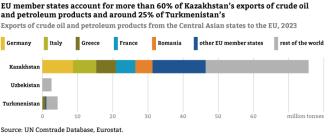
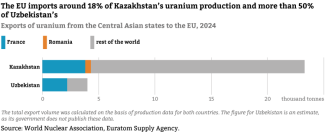
Since the 1990s, Poland has pursued energy cooperation with the Central Asian states and, more broadly, the Caspian region, with varying intensity. From the outset, this interest has been closely linked to efforts to diversify Poland’s oil and gas supplies and reduce its dependence on Russia. By providing political support for US and/or EU initiatives aimed at developing alternative export routes from the region, Poland has also indirectly supported the Central Asian states in lessening their reliance on Russia.
At the same time, the volumes of Central Asian energy resources reaching Poland have remained limited and have therefore played only a marginal role in replacing Russian supplies. Kazakh crude oil, purchased primarily on the spot market and accounting for no more than approximately 1–2% of Poland’s oil imports, has been supplied to the country since the late 1990s. Following Russia’s full-scale invasion of Ukraine, these volumes plummeted more than tenfold, most likely as a result of the suspension of imports via the Druzhba pipeline.
During the 2000s, Russia used Turkmen natural gas – and, to a lesser extent, gas from Uzbekistan and Kazakhstan – as leverage in its relations with certain European countries, including Poland. At the time, limited volumes of Turkmen gas reached Poland via Russian pipelines and were re-exported under an opaque arrangement involving RosUkrEnergo, a Ukrainian-Russian intermediary in which Gazprom held an indirect 50% stake. This practice came to an end in 2009.
Energy and raw materials have featured prominently in every EU strategic document on cooperation with both Central Asia as a whole and its individual republics. They constitute one of the key pillars of the Joint Roadmap for Deepening Ties between the EU and Central Asia, adopted in 2023 (see the chapter ‘In the shadow of the war in Ukraine...’), and form an integral part of the Global Gateway strategy and its associated infrastructure projects. In April 2025, as part of the implementation of the latter initiative, the President of the European Commission announced a new strategic partnership between the EU and Central Asia, backed by €2.5 billion in funding for the exploration, extraction and supply of critical raw materials from the region. The EU has also concluded bilateral partnerships with Kazakhstan (2022) in the fields of critical raw materials, batteries and renewable hydrogen, and with Uzbekistan (2024) on critical raw materials. Corporate activity is also gathering pace. In January 2024, German companies formed a consortium to develop lithium extraction in Kazakhstan. At the same time, Chinese, Western and South Korean companies have been exploring the country’s lithium deposits.
In recent years, Central Asia’s share of EU imports of critical raw materials has increased. Kazakhstan has expanded its role as a supplier of chromium (accounting for up to 25% of EU imports), phosphorus (22%), beryllium (around 9%), manganese (7%, mainly in the form of silico-manganese ferroalloys) and titanium. Uzbekistan has also increased its exports of gold to the EU, while Tajikistan has become a major supplier of antimony, accounting for almost 55% of EU imports in 2023.
Since 2022, European investors have continued to fund renewable energy projects across the region. In Kazakhstan, for example, they invested in hydrogen and ammonia production using wind and solar power (the German-Swedish Hyrasia One project) and in wind farms (the French Mirny project, supported by the EU). Although the estimated costs of producing and transporting green hydrogen and ammonia from the region remain high, current plans suggest that these energy carriers could meet a significant share of the EU’s demand. Finally, European financial institutions are also involved in hydropower projects in Kyrgyzstan and Tajikistan.
Polish companies have only a very limited presence in Central Asia’s energy, oil and gas and critical raw materials sectors. A handful of investments have been made in the energy sector in Kazakhstan and Uzbekistan, including power grid construction and, previously, extractive activities. At the same time, there is clear interest in the region and potential for increased investment, including in the energy and rare earth sectors. In the 2023 report on Polish outward investment published by PwC, PFR TFI and KUKE, both Kazakhstan and Uzbekistan ranked among the ten most attractive ‘non-obvious markets’ for Polish business, with Kazakhstan placing second behind Japan. In 2026, the Polish Investment and Trade Agency (PAIH) plans to open a foreign trade office in Uzbekistan, its second in Central Asia after the one in Kazakhstan.
2.4. Recommendations
It is in the interest of the EU and Poland to support the Central Asian states in achieving greater energy and resource independence, primarily from Russia but also from China. This is important not only in the oil and gas sectors, but also in the nuclear industry and in the many deep-rooted, and thus difficult to change, sectoral ties and technological partnerships. This objective can be advanced by facilitating foreign direct investment across different segments of the energy and raw materials sectors, including critical raw materials, supporting the development of local expertise and industrial capabilities and providing political backing for export routes (including those across the Caspian Sea and developed in cooperation with Turkey) and for production capacity independent of Russia and China.
Brussels and Warsaw should make it a strategic priority to ensure that Central Asia genuinely becomes an alternative to Russia as a supplier of energy (and potentially of clean energy and energy carriers such as hydrogen and ammonia) to Europe and other international markets, rather than a de facto extension of Russia’s market and influence in this sphere owing to various political and economic ties. This would increase the availability and diversity of energy supplies at both the regional and global levels, which should have a positive effect on competition and prices. At the same time, the weakening of Central Asia’s economic ties with, and exposure to pressure from, Russia would enhance the region’s resilience, autonomy and development potential in areas of particular interest to Europe, such as critical raw materials and green energy, while limiting Russia’s ability to use the region to circumvent sanctions.
From the EU’s perspective, Central Asia is an important source of raw materials considered critical for developing clean technologies and generating clean energy. At the same time, competition for access to these resources is already under way and, although individual EU member states are actively involved, the EU’s overall role remains limited. To properly define the scope for bilateral cooperation with Poland, it is necessary to map the demand for specific raw materials that are important to the Polish economy, a process that could form part of the planned update of the country’s raw materials policy or the proposed act on ensuring access to critical raw materials. From Warsaw’s perspective, it is also important to shape its own engagement and influence the EU’s approach in a way that ensures a level playing field for cooperation with entities from different member states in Central Asia’s strategic raw materials sector, while also creating room for cooperation with the United States rather than fuelling competition.
Intense competition in Central Asia’s energy and raw materials sectors, strong interest in the region from companies around the world and the high cost of investment make it difficult for Polish companies to undertake projects independently in sectors regarded as strategic. Poland should therefore seek to play an active role in EU initiatives, including the Team Europe Initiative on Water, Energy and Climate Change in Central Asia, which would enable it both to help shape the EU’s engagement and to map out investment opportunities.
Poland could also seek to engage directly while promoting greater EU involvement in expanding Central Asia’s domestic capacity for processing and recycling critical raw materials, alongside fostering joint research and development and the exchange of expertise in this field. This approach would strengthen bilateral ties in this critical sector while enhancing the region’s potential, notably by supporting the diversification of its economies and increasing its autonomy vis-à-vis Russia and China in this area.
It would also be desirable to integrate Central Asia into the international dimension of the EU’s climate policy, particularly into its Polish vision, which places greater emphasis on the cost-effectiveness of reducing emissions, achievable in part through international cooperation. The region is not only a potential source of critical raw materials and/or green energy carriers for EU member states (although securing them could prove logistically complex and costly), but also an area with considerable potential for reducing emissions itself and advancing its own energy transition. Such efforts appear promising given the scale of greenhouse gas emissions generated by the Central Asian states and the ambitious climate targets they have set themselves, notably Kazakhstan’s aim to achieve climate neutrality by 2060. Implementing emissions trading systems across Central Asia, ideally compatible with the EU’s ETS, would be a key step towards achieving these objectives.
Such proposals should be broadly consistent with the EU’s current thinking on changing how European entities meet their commitments to reduce emissions by opening up to international emissions trading and carbon offsets. Directing this opening towards, among others, the Central Asian republics, for example within the Eastern Partnership+ framework, could allow part of the EU’s climate objectives – particularly in sectors that are difficult for EU member states, including Poland, to decarbonise – to be achieved abroad through the purchase of emissions reduction credits generated in the region, including under Article 6 of the Paris Agreement. Cooperation in this field would support Central Asia’s transition and reduce its consumption of hydrocarbons, while strengthening its ties with the EU and potentially helping it to meet growing domestic demand, thereby freeing up additional energy resources for export to global markets. Moreover, developing decentralised green energy sources would help alleviate the region’s recurring seasonal shortages of electricity and water. At the same time, the EU and Poland would contribute to reducing global emissions in a manner that places less strain on their own economies.
Agata Łoskot-Strachota, with research assistance (data collection and analysis) from Daria Zielińska
3. Connectivity first? Transport issues
3.1. Improving transport connections with the West
Central Asia’s geographical location at the crossroads of Europe, Russia, East Asia and the Middle East makes it a natural bridge for Eurasian trade. However, the region accounts for only a marginal share of global trade (less than 1% in 2023 according to the WTO), reflecting long-standing geographical, infrastructural, investment and political constraints. The main challenges include its vast territory and distance from major markets, the need for substantial investment in transport infrastructure – much of which was inherited from the Soviet Union, remains oriented towards Russia and hinders regional integration – and the lack of access to the open seas, which increases transport costs.
Efforts to overcome Central Asia’s isolation, particularly from Europe, date back to the concept of a Trans-Caspian transport corridor (the Transport Corridor Europe-Caucasus-Asia, TRACECA, launched in 1993). However, this failed to develop into a major transport artery owing to instability in the countries along its route, the number of borders to cross and the preference for trade routes through Russia.
Central Asia’s importance as a transport corridor, particularly that of Kazakhstan, increased after the region was included in China’s Belt and Road Initiative, announced in Astana in 2013. Although this project did not alter the region’s role as a transit zone between the world’s principal trading centres, with Kazakhstan serving as a major transport hub, it did stimulate targeted infrastructure investments. China benefited the most from this initiative, both economically and politically, consolidating its position as one of Central Asia’s principal partners alongside Russia after expanding its economic presence during the previous decade. In 2013, Kazakhstan, Azerbaijan and Georgia established the Trans-Caspian International Transport Route (TITR) Association to steer the development of the China-Europe corridor in line with the region’s interests. Turkey later became an important participant in the initiative. Russia’s invasion of Ukraine in 2014 gave the project fresh impetus, but its development was hampered by insufficient funding to achieve its ambitious objectives.
Map 5. Overland transport corridors between Europe and China
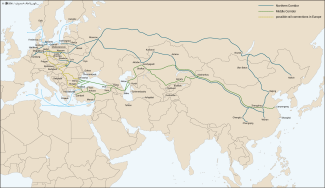
Russia’s full-scale invasion of Ukraine in 2022, coupled with developments unfolding independently within the region, prompted a significant shift in perceptions of transport connectivity between the EU and the Central Asian states, elevating it into one of the key pillars of cooperation between the two sides alongside energy and raw materials. As a result, the TITR gained significant momentum. Its development has been underpinned by the region’s inclusion in the EU’s Global Gateway strategy in 2021 and by a feasibility study of the route carried out by the European Bank for Reconstruction and Development (EBRD) at the request of the European Commission. With investment needs estimated at €18.5 billion, the study projected that the corridor could reach a capacity of 130,000 TEU by 2040.
A further boost to the TITR came in the autumn of 2023, when repeated attacks by Yemen’s Houthi rebels on commercial vessels in the Gulf of Aden disrupted shipping through the Suez Canal. This forced global shipping companies to reroute their vessels around Africa, adding around ten days to transit times between Asia and Europe.
The governments of Central Asia are seeking to develop transport links in all available directions without favouring any one route. They aim to leverage the current favourable political climate to overcome the region’s peripheral status and reduce its transport dependence on Russia, enabling Central Asia to play a more significant role in global trade. Greater openness to other partners is intended to strengthen the position of the Central Asian states in their relations with Russia, potentially allowing them to secure more favourable terms from Moscow, including with regard to its participation in developing the regional North-South corridor through Kazakhstan and Turkmenistan with access to Iranian ports (the International North-South Transport Corridor, INSTC). Uzbekistan, Turkmenistan and Kazakhstan are also seeking to develop transport routes via Afghanistan to Pakistan and India. Uzbekistan and Kyrgyzstan have secured China’s approval to participate in the construction of the China-Kyrgyzstan-Uzbekistan railway. At the 2023 Belt and Road Forum, Xi Jinping also endorsed efforts to develop the TITR, prompting Chinese entities to invest in the expansion of regional and cross-border infrastructure. Among the Central Asian states, Kazakhstan and, to a lesser extent, Uzbekistan have been expanding their transport networks most rapidly, although both have faced numerous obstacles, primarily financial. Transport and transit have the potential to become major drivers of economic development across Central Asia.
3.2. Opportunities and challenges
The importance of transport corridors linking Europe with Central Asia is growing as the EU seeks to develop logistics links with regions rich in critical raw materials, particularly rare earth elements. This stems from a growing recognition that routes passing through Russia can no longer be regarded as secure and that the EU has been losing ground to China in the competition for access to raw materials, largely because of its limited involvement in developing transport links with various parts of the world.
Today, the EU is less focused on increasing transit capacity to China and more on deepening economic ties with the Central Asian states themselves, largely to secure access to mineral resources and critical raw materials and, in the future, ‘green’ ammonia and hydrogen. From the EU’s perspective, efforts to develop the TITR also have a positive impact on political stability in the Central Asian states.
Concerns about the Kremlin’s aggressive policy, coupled with the prospect of attracting investment from the West, are encouraging the Central Asian states to pursue closer regional cooperation, resolve border disputes and coordinate their foreign policies to present themselves to key external partners as a unified bloc. At the same time, the development of transport across the region, including the TITR, continues to be constrained by limited route capacity, ageing infrastructure and cumbersome border procedures. Transport along this route remains less competitive than maritime freight or the Northern Corridor, provided the latter continues to offer a viable option amid escalating tensions. The TITR requires long-term infrastructure investment in a region that is still consolidating its internal stability, while political conditions, notably authoritarian systems of government, and the resulting economic environment continue to present serious risks for businesses.
The Caspian Sea remains the TITR’s principal bottleneck. This stems largely from falling water levels, which have dropped by 1.5 metres over the past decade, the resulting need for dredging works, challenging weather conditions on the sea and its partial freezing during winter. Nevertheless, infrastructure improvements and better coordination of procedures along the route could significantly increase its efficiency and make it an attractive corridor for improving connectivity with the Central Asian states. However, given the costs and transit times involved, it is unlikely to replace routes running through Russia in the foreseeable future.
3.3. Progress to date
Of the €10 billion pledged by the EU to support the development of the TITR, projects worth almost €3 billion are currently under way, including €1.47 billion financed by the EIB and €1.5 billion by the EBRD. The Central Asian states have made uneven and often delayed progress in absorbing these funds, with Turkmenistan making the slowest progress. Regulatory differences, bureaucracy and insufficient capacity to cooperate with foreign partners remain significant challenges. Moreover, concerns about high levels of corruption in Central Asia pose a major constraint for the EU and the private sector. As a result, instruments intended to accelerate infrastructure development in the region are channelled through EU financial institutions.
The Middle Corridor offers the prospect of reducing transit times between China and Europe to 15 days by 2040. Although some local sources claim that freight can already be transported along the route within that timeframe, this represents the shortest achievable journey rather than the average. Typical transit times remain between 35 and 45 days, well above the 10–12 days offered by the route through Russia. The success of these plans will depend primarily on investment in hard infrastructure – railways, ports and transshipment terminals, and to a lesser extent roads – across the region, with a particular focus on Kazakhstan, and on improvements to the soft aspects of transport, such as eliminating customs barriers and harmonising procedures. To this end, in June 2024 representatives of the European Commission, the five Central Asian states and several development institutions, including the EBRD, the EIB, the World Bank and the Asian Development Bank, established the TITR Coordination Platform in Astana to support the harmonisation of customs procedures. Another challenge is the digitalisation of these processes: to date, Kazakhstan remains the only country in the region to have implemented the eTIR system.
Map 6. Transport infrastructure along the Middle Corridor across the transit states
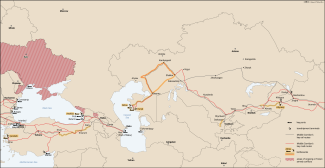
Cooperation to improve the efficiency of the TITR is delivering tangible results. The transport of liquid and dry bulk commodities – including grain, crude oil, certain raw materials, ores and metals, which constitute Central Asia’s traditional export products – continues to grow. According to ERAI, freight volumes along the Middle Corridor reached 3.3 million tonnes in 2024, up from 2.7 million tonnes in 2023.[2] Moreover, the route is increasingly used to transport higher-margin, highly-processed goods in containers between China and the EU. In 2024, container traffic along the corridor surged by 185% to 57,000 TEU, largely owing to the sharp increase in the number of container trains from China and disruptions to the traditional maritime route caused by attacks on container ships in the Red Sea. Improved coordination of transport services along the corridor among the transit countries and Xi Jinping’s political backing for shipments via this route at the 2023 Belt and Road Forum also contributed to this rapid growth. Even so, these volumes remain far below those carried along the Northern Corridor running through Russia, underscoring that the TITR is still at an early stage of development.
3.4. Recommendations
It is in Poland’s interest to support the development of the TITR. The route will increase the economic diversification of the Central Asian states, weakening Russia’s leverage over them and reducing its ability to influence Eurasian overland transport corridors. Fostering the development of the Middle Corridor should become an important component of a reformed Eastern Partnership.
The principal challenge for the development of the TITR is securing funding for infrastructure projects. Poland should consistently press the European Commission to provide financial support for expanding the corridor. It should also encourage Polish logistics companies to engage in the development of the route and keep them informed about opportunities to win contracts for projects financed under the Global Gateway initiative.
A cautious dialogue with China and Turkey on expanding the Middle Corridor is warranted. On the one hand, China could support the route through subsidies, facilitating the development of logistics chains. On the other, it could use the corridor as a vehicle for expanding its presence in Central Asia and securing EU-funded contracts. Turkey, for its part, has the potential to play an important transit role along the route. It has been increasing investment in its rail network in anticipation of higher revenues from transit and cargo transshipment, while also wielding significant political influence in the South Caucasus.
Beyond financing, another major challenge will be to coordinate logistics procedures and border controls, which may require diplomatic support from the EU. Even if efforts to develop the TITR do not produce tangible results immediately, they represent an important contribution to the consolidation of Central Asia and to closer coordination between the Central Asian states and the countries of the South Caucasus. They could also help ease tensions in EU-Turkey relations.
Poland already possesses certain assets that could enable it to generate higher returns from logistics operations along the TITR. Should the situation in Ukraine stabilise, the Broad Gauge Metallurgy Line (LHS) and the transshipment hub in Sławków could be used to facilitate transit along the route. In addition, the Three Seas Initiative Investment Fund, in which Poland is the largest shareholder, holds a stake in the operator of the port of Burgas, Bulgaria. Moreover, PKP Cargo International has been actively expanding its rail connections with Romania and Bulgaria. Building on these assets, it is advisable to develop a coherent strategy aimed at capitalising on the development of the Middle Corridor.
Table 3. Key milestones in the development of the TITR
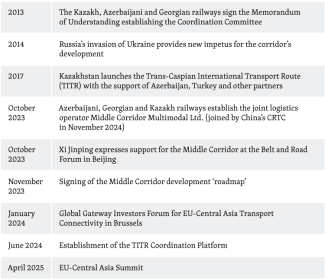
Source: author’s own compilation.
Table 4. Progress in implementing projects critical to improving the efficiency of the TITR
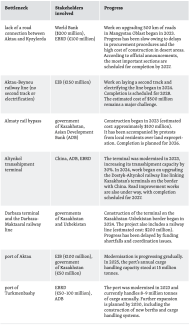
Source: author’s own compilation.
Konrad Popławski
IV. SOCIETY
1. Society: a new actor in the Central Asian states?
Central Asia is currently home to around 80 million people. Uzbekistan is the region’s most populous country (around 38 million), followed by Kazakhstan (around 20.3 million), Tajikistan (around 10.4 million), Turkmenistan (7.4 million) and Kyrgyzstan (7.1 million). Central Asia is experiencing rapid demographic growth, with all five republics recording sustained annual population increases of between 1.5% and 2%. Since the collapse of the Soviet Union, the populations of Tajikistan, Kyrgyzstan and Turkmenistan have almost doubled. However, Turkmenistan’s official figures in particular should be treated with caution: unofficial estimates suggest that the country’s actual population may be around half the reported figure, and the official statistics are believed to conceal the scale of mass emigration. Central Asia’s societies are young: in every country in the region, children under the age of 14 account for at least 30% of the population. UN demographic projections indicate that this trend is likely to continue.
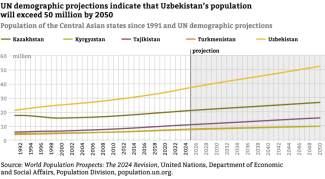
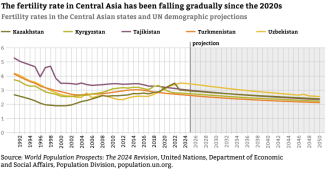
Over the past three decades, the region’s ethnic composition has shifted in favour of the titular nations. Lower birth rates and large-scale emigration after 1991 have led to a lasting decline in the share of the Slavic population, including ethnic Russians, although they continue to constitute a sizeable, geographically concentrated minority in northern Kazakhstan.
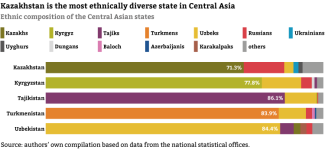
The Central Asian states are at different levels of social and economic development. Kazakhstan is by far the wealthiest, with GDP per capita (purchasing power parity) of $40,800. It is followed by Turkmenistan ($20,400), largely owing to high revenues from natural resource extraction, which have not translated into broader prosperity for the population. The figure stands at $11,800 in Uzbekistan, $8,000 in Kyrgyzstan and $5,400 in Tajikistan (compared with $50,400 in Poland). Although poverty statistics are incomplete, they suggest that as many as one in three people in Kyrgyzstan and one in four in Tajikistan live below the poverty line. The Central Asian states have low or moderate urbanisation rates, ranging from 28.2% in Tajikistan to 58.2% in Kazakhstan. Tajikistan has the highest unemployment rate at 11.6%, while in the other republics the figure ranges between 4% and 5%. Labour markets across the region are characterised by low female labour force participation and discrimination against women.
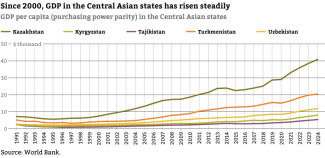
Education data are incomplete and do not provide a clear picture of the overall level of education in Central Asian societies. However, it is clear that the entire region struggles with persistent infrastructure deficiencies and staffing shortages, which undermine the quality of education. There is also a significant risk of exclusion from the education system in rural areas. At the same time, the region’s young population and rising aspirations are driving strong demand for education, including higher education. Moreover, governments across Central Asia have been encouraging foreign entities, including those from the EU, Russia and Turkey, to establish educational institutions ranging from schools at different levels to universities.
The social situation in the region presents major challenges to its political and economic systems and indicates that the long-standing development model based on its peripheral status and dependence on Russia has reached its limits. Demographic pressures are forcing governments to provide employment for a growing number of citizens and, in an optimal scenario, to undertake far-reaching economic transformation. Uzbekistan alone needs to create up to one million new jobs each year.
This problem has traditionally been mitigated through large-scale labour migration, primarily to Russia, with remittances accounting for a substantial share of GDP. In 2024, they amounted to 17.7% of GDP in Kyrgyzstan, 47.9% in Tajikistan and 14.4% in Uzbekistan. According to partial data for 2024 and 2025, the vast majority of remittances to Uzbekistan (almost 80%), Tajikistan (around 90%) and Kyrgyzstan (more than 90%) originated in Russia. However, this mechanism for easing social pressures through large-scale migration to Russia is becoming increasingly ineffective owing to the growing supply of labour across the region, driven by population growth, and the consequences of the war in Ukraine, including Russia’s mounting economic difficulties and discrimination faced by Central Asian migrant workers. Migration to alternative destinations (see the chapter ‘Central Asia on the move’) has not been sufficient to address this challenge. All five Central Asian republics, particularly Uzbekistan, have been pursuing ambitious efforts to modernise and industrialise their economies, but have encountered significant obstacles, including limited access to technology and capital, as well as shortcomings in their education systems. These factors, in turn, have shaped the priorities of governments across the region.
Generational and identity shifts are a key component of the social transformation taking place across Central Asia. On the one hand, nationalist and re-traditionalist movements, often with a strong Islamic dimension, are gaining momentum. On the other, demands for modernisation and rising social aspirations are becoming increasingly prominent, ranging from the pursuit of higher material living standards to greater public concern over issues such as domestic violence.
The region’s socio-economic conditions pose serious political challenges, requiring far-reaching adjustments to development strategies and making the stability of individual countries increasingly dependent on the effectiveness of top-down reforms. Authoritarian systems have either failed to establish, or have actively suppressed attempts to establish, institutions and mechanisms that would enable citizens to participate in political life and help defuse social tensions. These regimes derive their legitimacy primarily from maintaining stability and meeting people’s material aspirations. Frustration with social conditions has already generated tensions and triggered socio-political crises, as seen in Kazakhstan in 2022. Alongside Russia’s role, demographic factors – including generational change, identity shifts and rising aspirations – are the key variables shaping the predictability of developments in Central Asia.
1.1. Central Asian societies in EU and Polish policies
Engagement with Central Asian societies has been a consistent element of both the EU’s and Poland’s stated and implemented policies towards the region. Given the authoritarian nature of Central Asia’s political systems, opportunities to engage directly with local populations have so far been very limited, constraining political cooperation. Amid the rapid changes taking place across Central Asia, the EU has maintained its interest in the development of the region’s societies. However, it now seeks to pursue this objective through pragmatic cooperation with the governments of individual Central Asian states.
The EU continues to call for supporting civil society, with a particular focus on empowering women and young people, and for strengthening its role in shaping domestic reforms. Efforts by individual Central Asian states, such as Kazakhstan and Uzbekistan, to streamline public institutions and administration and to develop mechanisms for social ‘dialogue’ have provided some scope for engagement, creating opportunities to promote higher governance standards, including in the area of the rule of law, and to encourage the adoption of selected practices that foster public participation, for example at the local government level.
Supporting civil society appears feasible only in areas that avoid politically sensitive issues, such as activities at the local level, environmental and social issues (for example, the debate on domestic violence, which has intensified in recent years) and culture. A serious challenge stems from growing criticism in the West of the existing model of development assistance, resulting in the closure of USAID and the suspension of funding for numerous programmes by the Trump administration. This paradigm shift raises the prospect of terminating many projects and dismantling the institutional structures and human resources that underpin them.
However, the EU’s primary focus is on developing higher and vocational education, which – alongside cultural cooperation and the promotion of people-to-people contacts – is intended to foster economic cooperation with the region. Educational ties have expanded most rapidly, responding to strong local demand driven by a demographic boom, chronic underinvestment in education systems and the need for skilled personnel across the region. At the EU level, Central Asia has been included in programmes that facilitate access to education, such as Erasmus+, the Marie Skłodowska-Curie Actions, TEMPUS (Trans-European Mobility Programme for University Studies) and VET (Vocational Education and Training). Education appears to be the most promising avenue for engagement and cooperation with the region over the medium to long term. Administrative, business and educational professionals trained through EU-funded programmes offer the prospect of promoting Western standards across a range of fields over the long term.
For many years, Poland’s policy towards Central Asia focused particularly on development assistance, although its scale was much more limited than in the Eastern Partnership countries. Poland significantly reduced this support after 2015, when it removed the Central Asian states from its list of priority areas. The country’s policy has also prioritised support for the Polish diaspora, primarily in Kazakhstan, where around 35,000 people identify as ethnically Polish, through both repatriation programmes and initiatives to preserve and promote Polish identity. Another area of cooperation, partly pursued through government policy, is education, including student exchanges and the establishment of educational institutions in the region.
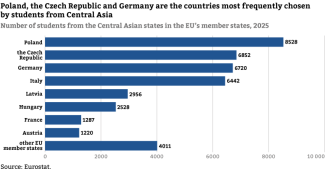
1.2. Recommendations
Efforts to promote democracy and support civil society will remain an element of the EU’s policy towards Central Asia. At the same time, their effectiveness has been and is likely to remain limited, as the region lacks both the necessary legal and institutional conditions and the political will to support such efforts. EU member states should work with the Central Asian states to develop a model of cooperation in this area. The suspension of US development assistance to the Central Asian republics should prompt a review of cooperation by the EU and its individual member states with these countries in order to explore options for sustaining existing projects and retaining the personnel whose work previously depended on US funding.
For Poland, education, particularly higher education, offers the most promising avenue for engagement with Central Asian societies. The enrolment of students from Central Asia helps meet the needs of Polish universities while also creating opportunities to educate the region’s future political and business elites and build positive relationships with them. Investing in this dimension of cooperation appears essential for securing a future Polish presence in the region. It is also worth noting that Poland leads EU member states in terms of the number of students from Central Asia (see chart above). However, success in this area will depend on developing an efficient visa system that is resistant to abuse (see the chapter ‘Central Asia on the move’). Poland should complement this approach by promoting the Polish language and culture across Central Asia, with a view to attracting both prospective students and labour migrants.
In light of the experience of the past three decades, it is advisable to develop more effective mechanisms for maintaining and leveraging ties with Central Asian graduates of Polish universities, particularly those with professional or personal links to Poland. This could include government support for platforms bringing together higher education institutions and relevant ministries to collect and process information on these individuals. Another option would be to establish, with the involvement of Poland’s diplomatic missions in the region, cultural institutions (‘Polish Houses’) tailored to the regional context and responsive to local sensitivities and needs. These would serve as hubs for bringing together people connected to Poland, while also facilitating Polish economic engagement.
As noted above, the fundamental prerequisite for the success of any efforts to strengthen ties with Central Asia in the areas of education, migration and business cooperation is the establishment of an effective system for regulating and managing the entry and residence of Central Asian nationals in Poland that is equipped to address contemporary challenges. Without an efficient and credible framework governing issues such as visa issuance and residence arrangements for migrants from the Central Asian republics in Poland, any efforts to engage with Central Asian societies and any resulting benefits for Poland will remain very limited.
It would also be worthwhile to initiate a debate on the existing approach to the Polish minority in Kazakhstan. On the one hand, Poland has developed mechanisms enabling interested individuals to restore or maintain their ties with the country, including repatriation and extensive privileges associated with the Pole’s Card. On the other, the experience of recent decades suggests that hopes of reversing the multi-generational trend among the Polish minority towards closer identification with Russian culture and identity are unlikely to be realised. This trend is reflected in a strong sense of affinity with the Russian minority, the everyday use of the Russian language and deep-rooted connections to the Russian media and cultural space.
Krzysztof Strachota, Zuzanna Krzyżanowska
2. Central Asia on the move: migration from the region – the case of Poland
2.1. The Central Asian migration model
Migration from Central Asia – traditionally oriented primarily towards Russia, although in recent decades increasingly towards Poland and other EU member states – constitutes an integral feature of social life across the region. The roots of contemporary migration date back to the 1970s. Initially, those leaving the region were predominantly Slavic settlers, exiles and their descendants (the so-called post-colonial migrants). At the peak of this migration wave, from the late 1980s to around 2002, approximately five million ethnic Russians and Russian-speaking – that is, Russified – inhabitants of various backgrounds, particularly European, left Central Asia. They headed mainly to European countries such as Germany and Ukraine, as well as to Russia, Israel and Turkey. Today, migration from Central Asia is driven primarily by the region’s indigenous populations, who leave mainly for economic reasons, often relying on the networks and migration patterns established by earlier waves of migrants.
Economic factors are the principal driver of migration from the region. Underdeveloped economies – particularly those of Tajikistan, Kyrgyzstan and Turkmenistan – are unable to provide sufficient employment opportunities and livelihoods for their populations. As a result, large-scale, structural labour migration, particularly seasonal migration, has become a permanent feature of the region. In the previous decade, remittances from migrants from Tajikistan and Kyrgyzstan accounted for between 30% and 50% of the two countries’ GDP; in 2024, they still ranged from approximately 18% to 48%. At their peak, these migration flows involved up to 10% of the population residing abroad on a temporary basis; unofficial data from Turkmenistan suggest that as many as half of its citizens may live outside the country. The challenge is becoming more acute as the demographic bulge enters the labour market.
Labour migration is actively encouraged by individual Central Asian states, as it delivers socio-economic benefits and helps contain immediate threats to the stability of their authoritarian regimes by facilitating the departure of the most active individuals and social groups, particularly young men, who are viewed by their governments as posing a potential threat. Mass migration is a shared cultural experience across the region. According to UN data, 6.3 million people from Central Asia were living abroad on a permanent basis as of mid-2024. Citizens of Kazakhstan (2.8 million) and Uzbekistan (2.1 million) made up the largest share of this group, followed by those from Kyrgyzstan, Tajikistan (0.5 million each) and Turkmenistan (0.4 million). Taken together, they accounted for approximately 8% of the combined population of the five Central Asian states.
Over the past decades, Russia has been the principal destination for migrants from Central Asia owing to its accessibility, relative cultural proximity stemming from post-colonial ties, well-established Central Asian diasporas and extensive social networks. Migrants from the region have worked in Russia on a seasonal or temporary basis or have settled there permanently, seeking to integrate by starting families and acquiring Russian citizenship.
In recent years, however, this model has begun to reach its limits. This has been driven by the depreciation of the Russian rouble since 2022 and the resulting decline in the value of remittances from labour migrants, the growing number of cases in which migrants from Central Asia have been forcibly recruited into the Russian Armed Forces and deployed to fight in Ukraine, and the rapid spread of xenophobia, Islamophobia and racism, particularly following the terrorist attack carried out by Tajik citizens in Moscow in 2024. The Central Asian states themselves are also seeking to diversify labour migration. Alongside purely economic considerations, this stems from concerns that Moscow could exploit their dependence on the Russian labour market for political purposes. Alternative destinations include Turkey, EU member states, South Korea, China, Israel, the Gulf states, the United Kingdom and Japan. Migrants leave Central Asia primarily for work, education (particularly in Turkey, the EU, China and South Korea) and, to a much lesser extent, to seek refuge or for other political reasons (mainly in the EU). Most do so independently, while organised migration is less common and primarily involves Uzbekistan’s contract worker system, particularly for employment in South Korea and Israel, and state-supervised programmes for labour migration to East Asia and the EU.
2.2. Migration to Poland
People from Central Asia have been migrating to Poland since the early 1990s. The first group consisted of repatriates of Polish origin. Between 1997 and 2019, citizens of Kazakhstan accounted for the largest share (53.3%) of the 6,239 approved repatriation applications. In recent years, however, labour migrants have come to dominate these flows. This shift reflects both the strong interest among Central Asians in gaining access to the Polish labour market and Poland’s growing demand for foreign workers, driven by rapid economic growth, mounting challenges arising from demographic change and Polish emigration to Western countries.
The number of Central Asians interested in pursuing education in Poland is growing, while a small group (primarily Tajik nationals) has sought international protection on political grounds. The phenomenon of ‘welfare migration’, well known in Western Europe, has not emerged in Poland. Over the past two years, the number of Central Asian nationals in Poland has doubled. As of October 2025, around 24,000 were registered in the country, nearly half of them Uzbeks, followed by citizens of Kazakhstan, Turkmenistan, Tajikistan and Kyrgyzstan.
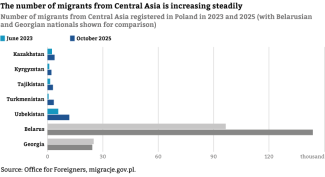
The actual number of Central Asian migrants in Poland is likely to be higher, owing to the specific nature of the registration system. The discrepancy between the official and actual figures stems from several factors, including the lengthy process of legalising residency and secondary migration from other EU member states, such as the Baltic states, Hungary, Slovakia and Germany, as migrants seek to circumvent Poland’s restrictive visa policy. Migration from Central Asia to Poland remains largely temporary and circular, with many migrants dividing their time between Poland and their countries of origin, where their families continue to live. Poland also serves as a transit country on the way to Western Europe. Most migrants appear to regard Poland as such, including, it seems, all those who enter Poland irregularly via Belarus, Lithuania, the Czech Republic and Slovakia.
Central Asian migrants find employment primarily in agriculture, food processing, construction (particularly renovation work), retail, services, hospitality, manufacturing, transport and logistics. They continue to work mainly in manual occupations and are employed largely as low-skilled labour, although their share among long-distance lorry drivers, IT specialists, software developers and managers has been steadily increasing, particularly among citizens of Kazakhstan and, to a lesser extent, Uzbekistan. Labour migrants from Central Asia are regarded as valuable and sought-after employees because of their discipline, strong work ethic and non-demanding attitude. Another significant advantage is their previous experience of working in Russia, Ukraine, Turkey, Germany, Lithuania and other labour markets. These qualities are particularly valued in Poland when compared with the qualifications of individuals arriving in large numbers from other parts of Asia, Africa and South America (people from around 150 countries currently work in Poland). The labour market niche for guest workers is expanding due to increasing depopulation coupled with rapid economic growth.
Poland’s attractiveness as a migration destination stems from a number of factors, including stable employment, transparent labour market rules (particularly compared with Russia), a relatively low cost of living that offsets lower wages than in Western Europe, and the opportunity to hold multiple jobs simultaneously, especially in large urban centres. Socio-cultural factors also play an important role. These include favourable perceptions of social conservatism, the visible role of religion, the relative linguistic proximity between Polish and Russian, which serves as a lingua franca for a significant proportion of arrivals, the presence of sizeable Russian-speaking communities (from Ukraine, Belarus and Georgia) that act as intermediaries, and the still negligible presence of ethnically based organised crime compared with Western Europe.
2.3. Recommendations
Given both the abundant supply of labour from Central Asia and the high demand for it, migration from the region to the EU’s member states, including Poland, should be regarded as a long-term trend that is likely to intensify. Migration pressure could increase further if social and security challenges in the region continue to deepen.
The primary challenge outlined in the migration strategy adopted by the Polish government in 2024, entitled ‘Regain control, restore security’, is to develop a new model for managing migration, including flows from Central Asia. This requires adapting existing institutions and adopting implementing legislation that safeguards the security of the state and its citizens in the broadest sense, while responding directly to Poland’s development needs. In the case of migrants from Central Asia, it is essential to establish a coherent and transparent visa policy and an effective screening system for both labour migrants and students, alongside mechanisms for cooperation between central government institutions, local authorities and employers in managing access to the labour market. Across all these dimensions, Poland will need to adapt and strengthen its institutional capacity, human resources and expertise. One of the greatest obstacles to legal migration from Central Asia to Poland is the absence of readmission agreements with all the states in the region except Kazakhstan.
Regardless of the preferred model for managing foreign nationals arriving directly from their countries of origin, it is also necessary to develop solutions for those entering Poland from other EU member states. This includes security screening conducted in cooperation with the security services of other member states and monitoring individuals already residing in Poland. Moreover, it is important to streamline and accelerate the legalisation of residence and employment, provided the relevant requirements are met. The absence of regulation in this area risks fostering the informal economy and, over time, increasing the scope for criminal exploitation of migration, including by ethnically based organised crime. It should be noted that migrants from Central Asia, as a smaller and less established migrant community, are particularly vulnerable to exploitation by criminal groups run by Ukrainian or Georgian nationals. A more extreme risk, though one that has been observed in both Western Europe and Russia, is the religious and political radicalisation of individual migrants.
It appears essential to develop both general integration programmes and those specifically tailored to migrants from Central Asia. At different stages of the migration process, members of this particular group face a range of problems stemming from limited knowledge of Polish law, which restricts their access to state institutions and public services, and from language barriers and difficulties with cultural adaptation. When employers are left to address these challenges on their own, foreign nationals are typically pushed into the informal economy and become vulnerable to misinformation and disinformation, as they tend to rely on Russian-language online sources.
Whether migration from Central Asia should be channelled through cooperation with the countries of origin remains an open question. The most developed programmes operate in Uzbekistan, where the state, under bilateral agreements, organises the recruitment of workers while also facilitating pre-departure vocational and language training and the screening of workers. These arrangements are used extensively by countries such as South Korea, Israel, Japan, Germany and France. One ambiguous aspect of this cooperation with authoritarian Central Asian regimes is the degree of control exercised over migrants by their security services. On the one hand, this mitigates risks and facilitates cooperation in responding to security threats. On the other, it expands the operational reach of these agencies (and of cooperating security services from other countries) within Polish territory and makes it easier for them to monitor individuals regarded as a threat to their respective regimes.
Mariusz Marszewski, with contributions from Krzysztof Strachota
[1] For more on this issue, see: I. Wiśniewska, F. Rudnik, A game of cat and mouse. How Russia is circumventing sanctions, OSW, Warsaw 2025, osw.waw.pl.
[2] Kazakhstan Railways estimated freight traffic along the corridor at 4.1 million tonnes in the period from January to November 2024. See: ‘Cargo Transport along Middle Corridor Surges by 63% in 2024’, The Caspian Post, 18 December 2024, caspianpost.com.


